

Beyond Your Paycheck: Do You Understand Your Employee Benefits?
When you think about what you earn at work, your salary or hourly wage probably comes to mind first. It’s the number you see in a job offer, use to build your budget, and consider when evaluating a new opportunity. But your paycheck may represent only part of what your employer provides.
Health insurance, retirement contributions, disability coverage, paid leave, and other workplace benefits can play an important role in your financial life. Some reduce expenses you would otherwise pay yourself. Others help you save for the future or provide financial support during unexpected circumstances.
What are employee benefits? Employee benefits are forms of compensation or workplace support provided in addition to regular wages or salary. Depending on the employer, they may include health insurance, retirement contributions, paid leave, insurance coverage, and other programs.
The challenge is that employee benefits can be complicated. You may have enrolled in a plan when you started your job, made a few selections during open enrollment, and rarely looked at the details again. Understanding your benefits doesn’t mean you need to become an insurance or retirement plan expert. It means knowing what your employer offers, what you’re paying for, and which questions are worth asking
Your Compensation Is More Than Your Salary
Your total compensation may include much more than the money deposited into your bank account. Depending on your employer, your benefits package could include health, dental, and vision insurance; retirement plan contributions; life and disability insurance; paid leave; educational assistance; and other programs.
Some benefits are paid entirely by your employer. Others require contributions from your paycheck. Some are available automatically, while others require you to enroll or meet eligibility requirements. These differences matter when evaluating your overall compensation. Two jobs with similar salaries may offer very different benefits packages. Likewise, a higher salary doesn’t necessarily mean a better overall compensation package if you’re paying substantially more for healthcare or losing valuable employer contributions.
Start by locating your employer’s benefits guide or benefits portal. If your employer provides a total compensation statement, that can also help you see the broader picture.
Understanding Your Employee Health Insurance Benefits
Health insurance is often one of the most significant, and confusing, parts of an employee benefits package.
When reviewing coverage, it’s tempting to focus on the amount deducted from each paycheck. But the premium is only one part of the cost. Here are several terms worth understanding:
Premium: The amount paid to maintain insurance coverage. With employer-sponsored insurance, the employer and employee may share this cost.
Deductible: The amount you generally pay for covered healthcare services before certain benefits begin paying, subject to your plan’s terms.
Copayment: A fixed amount you may pay for a covered healthcare service, such as a doctor’s visit or prescription.
Coinsurance: The percentage of the cost of a covered service you may be responsible for paying.
Out-of-pocket maximum: The most you pay for covered, in-network services during a plan year, subject to plan rules. Premiums and certain other expenses generally do not count toward this limit.
These numbers work together. A plan with a lower premium may have a higher deductible or different cost-sharing requirements. A plan with a higher premium may offer different coverage provisions that matter to your household.
The important question isn’t simply, Which plan has the lowest premium?
It’s How does this coverage work, and what might it cost under different circumstances?
Your employer’s Summary of Benefits and Coverage (SBC) is a useful place to compare available health plans. It provides standardized information about covered services, costs, and coverage limitations.
What About HSAs and FSAs?
Some employers offer accounts that can help employees set aside money for eligible healthcare expenses. 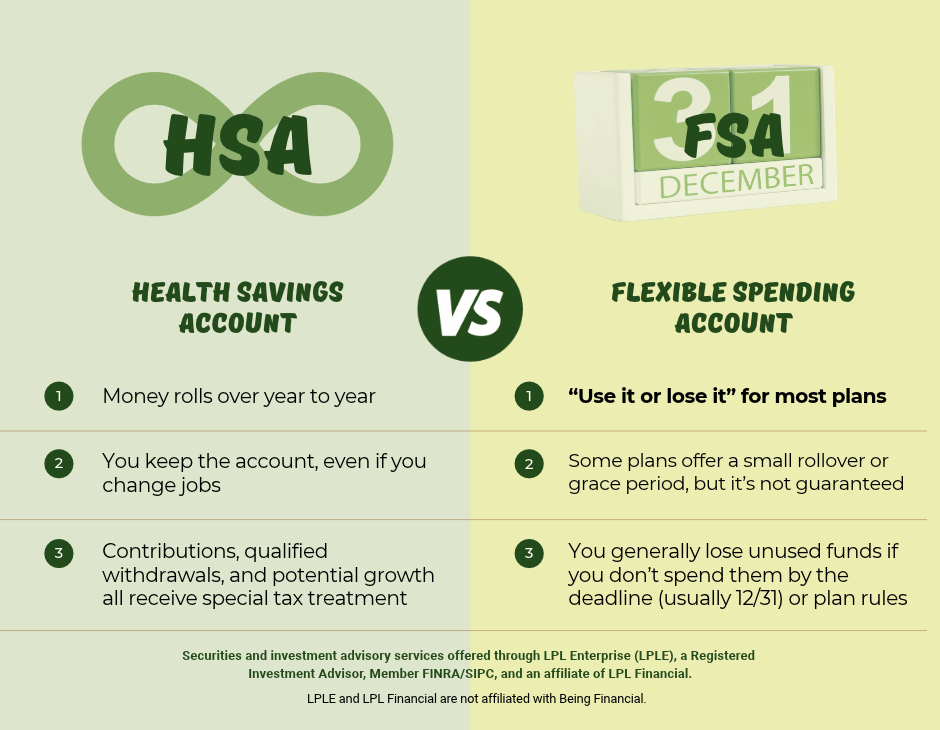
A Health Savings Account (HSA) is available to individuals who meet specific eligibility requirements, generally including enrollment in an HSA-eligible high-deductible health plan. HSAs offer certain tax advantages, and unused funds can remain in the account for future eligible expenses.
A Flexible Spending Account (FSA) is an employer-established benefit that allows eligible employees to set aside money for certain expenses using favorable tax treatment. Many healthcare FSAs have annual use restrictions, although some plans offer limited carryovers or grace periods.
HSAs and FSAs have different eligibility rules, contribution limits, and provisions. If your employer offers either option, understanding how it works can help you evaluate whether it fits your circumstances.
Don’t Overlook Benefits Beyond Health Insurance
Healthcare may receive the most attention during open enrollment, but other employer benefits can also have significant financial implications.
Retirement Plan Contributions
If your employer offers a retirement plan, such as a 401(k) or 403(b), review whether the employer contributes to your account.
Some employers match a portion of employee contributions. Others may provide contributions under different arrangements.
It’s worth understanding the contribution formula, eligibility requirements, and any vesting schedule. Vesting determines when you gain ownership of certain employer contributions, and those rules can matter when changing jobs.
Life and Disability Insurance
Some employers provide basic life insurance or disability coverage, sometimes with options to purchase additional protection.
These benefits may help address financial risks associated with death, illness, or injury. However, coverage amounts, exclusions, eligibility requirements, and portability provisions vary.
Understanding what coverage you have, and whether it continues if you leave your employer, can help you identify questions for further review.
Paid Leave and Other Benefits
Paid vacation, sick leave, parental leave, dependent care assistance, educational benefits, and employee assistance programs may also contribute to your overall compensation.
Some benefits can reduce expenses, while others provide flexibility or support during significant life events.
Even if you don’t currently need a particular benefit, knowing it’s available may be useful when your circumstances change.
When Should You Review Your Employee Benefits?
Annual open enrollment is an obvious opportunity, but it shouldn’t be the only time you think about your benefits.
Starting a new job, getting married, having a child, experiencing changes in household healthcare needs, or approaching retirement can all make a benefits review worthwhile.
Changing jobs deserves particular attention. Before leaving an employer, it may be helpful to understand when existing coverage ends, whether certain benefits can continue, what happens to employer retirement contributions, and what coverage will be available through your next employer.
Some benefit changes are permitted only during designated enrollment periods or after qualifying events, and deadlines may apply.
A periodic review can also help you recognize changes to your employer’s plans or benefits that you may have overlooked.
Employee Benefits Checklist: What Should You Review?
You don’t need to evaluate every benefit in one sitting. Start by identifying what you have and what you don’t yet understand.
Use these questions as a starting point:
☐ What benefits does my employer offer? Review your benefits guide or employee portal, including options you may not currently use.
☐ Which benefits am I enrolled in? Confirm your current elections and coverage details.
☐ What am I paying? Review payroll deductions, premiums, and other employee contributions.
☐ What is my employer contributing? Look at health insurance contributions, retirement plan contributions, and other employer-paid benefits.
☐ Do I understand my healthcare costs? Review your deductible, copayments, coinsurance, out-of-pocket maximum, and network provisions.
☐ Am I familiar with my retirement plan? Check the employer contribution formula, eligibility requirements, and vesting provisions.
☐ What insurance coverage do I have beyond health insurance? Review life and disability coverage, including applicable limitations.
☐ Are my beneficiary designations current? Review applicable retirement accounts and insurance policies.
☐ Have my circumstances changed? Consider whether your current benefit elections still reflect your household’s needs.
☐ What questions should I ask? Identify anything you don’t understand and contact your HR department or benefits administrator for clarification.
You may discover that your current benefits are appropriate for your circumstances. You may also find an option you didn’t know existed or a provision worth investigating.
Either way, the value of reviewing your benefits comes from understanding your choices.
Your Benefits Are Part of Your Financial Picture
Employee benefits aren’t separate from your financial life. They can influence your household budget, retirement savings, insurance coverage, career decisions, and ability to navigate unexpected changes.
Understanding your benefits is one way to become more informed about the financial resources available to you.
You don’t need to know every answer. Start by learning what you have, what it costs, and where to find reliable information when questions arise.
Your paycheck tells you what you’re earning today. Your benefits package can tell you more about the financial resources available to you along the way.
Understanding Your Benefits Is a Good Place to Start
Your employee benefits are one piece of your overall financial picture. Understanding what you have, how it works, and how it fits with your other financial resources can help you make more informed decisions. Explore more financial planning resources from Being Financial.
This material was created for educational and informational purposes only and is not intended as ERISA, tax, legal or investment advice. If you are seeking investment advice specific to your needs, such advice services must be obtained on your own separate from this educational material