
Financial Planning Designed Around Your Life, Not Just Your Money
We help individuals, families, business owners, and retirees coordinate retirement, tax, investment, estate, and risk planning into one clear strategy.
Financial planning in the Shenandoah Valley often involves more than investments or retirement accounts alone. For many individuals, families, business owners, and retirees, financial decisions around taxes, retirement income, estate planning, investments, and long-term care become increasingly interconnected over time. It’s about building a strategy that supports your life, your relationships, your work, and the future you want to create.
At Being Financial, we help individuals, families, business owners, and retirees throughout Harrisonburg, Charlottesville, the Shenandoah Valley, Virginia and beyond coordinate retirement planning, tax strategies, investments, estate planning, risk management, and legacy decisions into one clear direction.
Some clients come to us wondering if they can retire. Others are navigating a business transition, caring for aging parents, preparing for the next generation, or simply trying to organize years of financial decisions into a plan that finally feels connected. Our role is to help simplify complexity, identify opportunities, and create a planning process centered around your goals, values, and long-term priorities.
What Comprehensive Financial Planning Actually Includes
Financial planning works best when the different parts of your financial life are coordinated together, not managed in isolation. At Being Financial, our planning process is designed to help connect decisions around retirement, taxes, investments, risk management, and legacy planning into one strategy built around your life and priorities.
Retirement Planning
Retirement planning is about more than reaching a certain number. We help clients evaluate retirement income, spending needs, Social Security timing, healthcare considerations, taxes, and long-term sustainability so they can make informed decisions about the future.
Tax Strategy
Taxes can affect nearly every financial decision you make. We help clients evaluate strategies related to retirement distributions, Roth conversions, tax diversification, charitable giving, business transitions, and long-term tax efficiency as part of a broader financial plan.
Investment Management
Investments should support your goals, timeline, and risk tolerance — not exist separately from the rest of your financial life. We help clients build and manage investment strategies that align with their broader planning needs, income goals, and long-term priorities.
Estate Planning Coordination
Estate planning is about preparing the people, decisions, and documents that help support your wishes and simplify transitions for your family. While we do not provide legal services or draft legal documents, we often collaborate with attorneys and other professionals to help coordinate planning conversations and implementation.
Risk Management
Unexpected events can disrupt even well-built plans. We help clients evaluate areas of financial risk including insurance coverage, liability protection, long-term care considerations, disability planning, and strategies designed to help protect assets and income over time.
Social Security & Medicare Planning
The timing of Social Security and Medicare decisions can have a meaningful impact on retirement income and long-term planning. We help clients evaluate how these decisions fit into their broader retirement strategy, tax situation, healthcare planning, and income needs.
Long-Term Care Planning
Long-term care planning involves preparing for potential healthcare and support needs later in life. We help clients evaluate self-funding strategies, insurance options, hybrid solutions, and ways to incorporate care planning into a broader retirement and legacy strategy.
Charitable Giving & Legacy Planning
For many families, financial planning includes thinking beyond themselves. We help clients evaluate charitable giving strategies, family legacy goals, tax-efficient gifting opportunities, and ways to align wealth decisions with the people and causes that matter most to them.
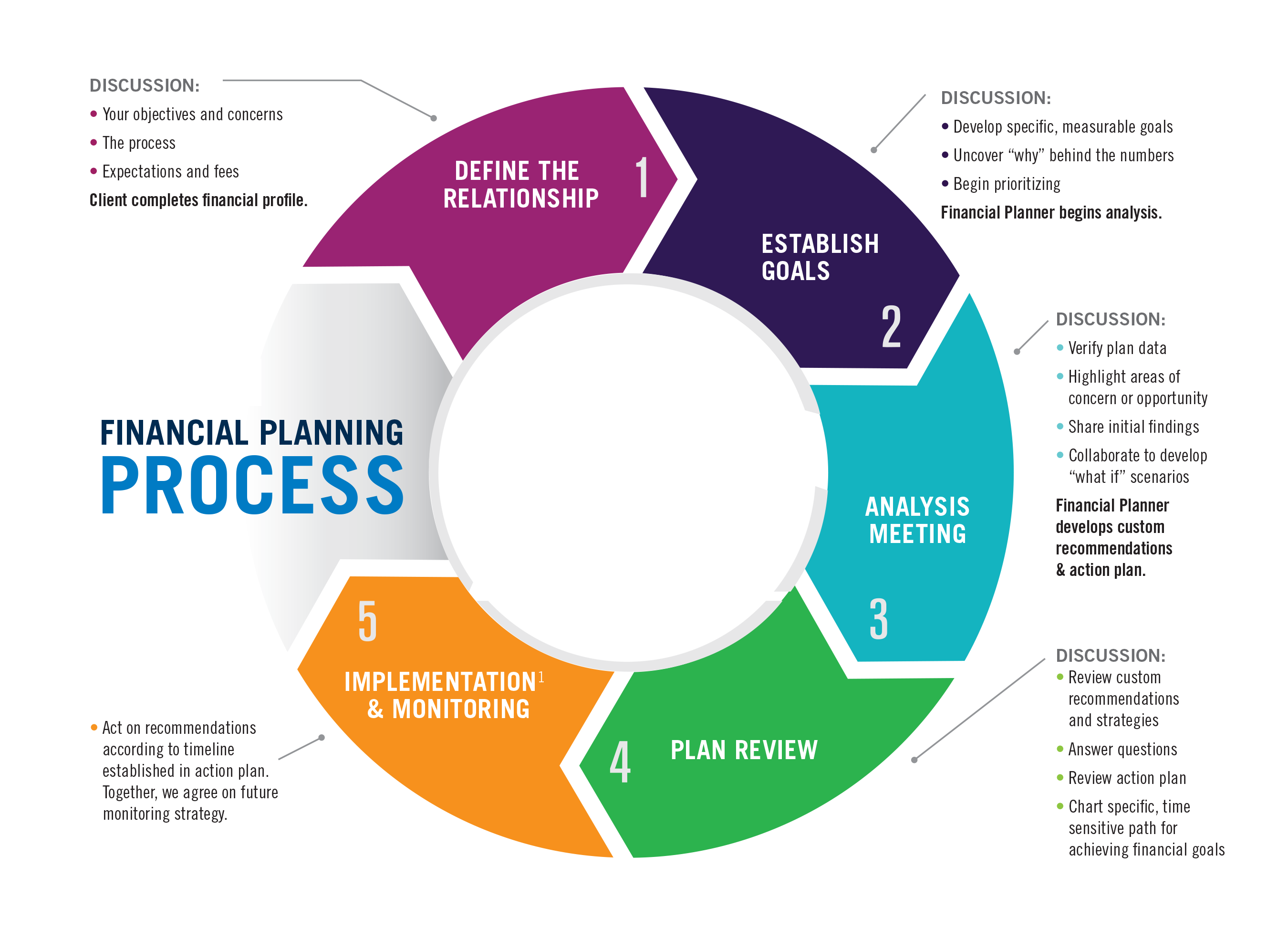
Our Planning Process
Financial planning can feel overwhelming when everything seems disconnected. Our process is designed to help organize the moving pieces, simplify complex decisions, and create a strategy that evolves with your life over time.
See what happens during each step
Step 1 Define the Relationship
Start the Conversation
Every planning relationship begins with a conversation.
We want to understand:
- what prompted you to reach out
- what concerns or opportunities are top of mind
- where you feel organized
- where things may feel uncertain or unfinished
- what matters most to you, your family, and your future
For some people, the conversation centers around retirement. For others, it may involve taxes, a business transition, investments, estate planning, or simply wanting a clearer sense of direction.
Step 2 Establish Goals
Organize the Financial Picture
Once we understand your goals and priorities, we begin organizing the key parts of your financial life into one coordinated view.
This may include:
- retirement accounts and investments
- income and cash flow
- tax considerations
- insurance and risk management
- estate planning documents
- business interests
- charitable goals
- long-term care considerations
Many clients tell us this is the first time they’ve seen everything connected in one place.
Step 3 Analysis
Build the Plan
After reviewing the information, we develop planning strategies designed around your goals, values, timeline, and financial realities.
Our goal is not to create unnecessary complexity. We focus on helping clients understand:
- what opportunities may exist
- what risks may need attention
- which decisions matter most right now
- what actions can reasonably be prioritized over time
Whenever possible, we aim to communicate recommendations in plain language with clear next steps.
Step 4 Plan Review
Implement Priorities
A plan only becomes valuable when it is acted on.
Implementation may involve coordinating with:
- attorneys
- accountants
- insurance professionals
- investment custodians
- business partners
- family members
Some changes happen quickly. Others may unfold gradually over several years depending on your goals and life stage.
Step 5 Continued Implementation & Monitoring
Continue Planning as Life Changes
Financial planning is an ongoing process, not a one-time event.
Life changes. Markets change. Tax laws change. Families change.
We continue helping clients evaluate decisions around:
- retirement transitions
- tax planning opportunities
- income strategies
- healthcare considerations
- business transitions
- estate updates
- legacy and charitable goals
The objective is not perfection. It is helping create a planning process that remains intentional, organized, and adaptable over time.
Common Reasons People Reach Out
People rarely seek financial planning because life is simple.
Most clients reach out during periods of transition, uncertainty, growth, or increased responsibility. Sometimes there is a major event driving the conversation. Other times, it is simply the realization that their financial life has become too important and too interconnected to manage without a clear strategy.
Common questions we help clients work through include:
“Am I on track for retirement?”
Many people want to understand whether their current savings, investments, and spending habits support the retirement lifestyle they envision.
“Can I retire at 62, or earlier?”
Retirement timing decisions often involve much more than age alone. Income needs, taxes, healthcare costs, investment strategy, and long-term sustainability all play a role.
“How do I manage taxes over time?”
Clients often want help understanding Roth conversions, retirement distributions, charitable strategies, tax diversification, and how different financial decisions may affect long-term taxation.
“Should I roll over my old 401(k)?”
As careers change, retirement accounts can become scattered across multiple employers and institutions. Many people want help evaluating consolidation, investment options, fees, and long-term planning considerations.
“How much risk should I actually be taking?”
Market volatility can raise important questions about portfolio structure, retirement income planning, diversification, and whether an investment strategy still aligns with current goals and risk tolerance.
“Do I need long-term care planning?”
Many families are concerned about preserving assets, maintaining flexibility, and preparing for potential healthcare needs later in life.
“How do I coordinate investments, taxes, and estate planning together?”
One of the most common frustrations people experience is feeling like every professional is working separately. Financial planning helps connect these conversations into a more coordinated strategy.
“How do I prepare my family for the future?”
For many clients, planning eventually becomes about more than themselves. Questions around legacy, charitable giving, business succession, family conversations, and multigenerational planning often become increasingly important over time.
Financial planning is not about having every answer immediately. It is about creating a process for making thoughtful decisions as life evolves.

Common Financial Planning Questions
Why do I need a financial plan?
A financial plan helps organize the different parts of your financial life into one coordinated strategy. Investments, taxes, retirement income, estate planning, insurance, and major life decisions often affect each other more than people realize.
Many individuals and families reach a point where financial decisions become too interconnected to manage effectively in isolation. Financial planning can help identify opportunities, simplify complexity, prioritize decisions, and create a clearer path forward.
For some people, that process begins with retirement planning. For others, it may involve preparing for a business transition, organizing investments, managing long-term taxes, or planning for the next generation.
Should I hire a financial planner?
Not everyone needs ongoing financial planning, but many people benefit from having a professional help coordinate important financial decisions.
Individuals often seek financial planning during periods of transition or increased complexity, including:
- approaching retirement
- selling a business
- managing significant assets
- planning for family or legacy goals
- navigating tax decisions
- preparing for long-term care considerations
A good financial planning relationship should help bring structure, perspective, education, and coordination to decisions that may have long-term consequences.
What makes financial planning different than investment management?
Investment management primarily focuses on building and managing portfolios.
Financial planning looks more broadly at how investments interact with retirement goals, taxes, estate planning, insurance decisions, income needs, business interests, charitable giving, and family priorities.
At Being Financial, investment decisions are generally viewed as one part of a larger planning process rather than the sole focus of the relationship.
What is values-based financial planning?
Values-based financial planning begins by understanding what matters most to the client, not just financially, but personally.
Goals are important, but values often help guide long-term decisions during changing life circumstances. Family, flexibility, stewardship, independence, generosity, work, lifestyle, and legacy can all influence how financial decisions are evaluated over time.
For many people, financial planning becomes less about simply accumulating assets and more about aligning resources with the life they want to build and the impact they want to have.
What is a one-page financial plan?
A one-page financial plan is designed to simplify complex financial information into a format that is easier to understand and act on.
While detailed analysis, projections, and supporting documents may exist behind the scenes, many clients prefer having a concise summary with key highlights such as:
- key priorities
- important decisions
- planning opportunities
- implementation steps
- areas requiring ongoing attention
>The goal is to create a planning framework that feels practical, understandable, and actionable rather than overwhelming.
How do I know if I’m financially on track?
That answer depends on several factors, including:
- retirement goals
- spending expectations
- savings habits
- taxes
- investment structure
- healthcare planning
- debt levels
- risk exposure
- long-term priorities
Many people have a general sense of where they stand financially, but may not fully understand how the different parts of their plan interact over time.
Financial planning helps organize these variables into a more complete picture so decisions can be evaluated with greater clarity and context.
Are you a fiduciary?
When providing investment advisory services through LPL Enterprise, we have a fiduciary responsibility to act in our clients’ best interests. This means we are required to put our clients’ interests first, provide advice that is appropriate based on their circumstances, and disclose material conflicts of interest.
At Being Financial, our planning approach is built around understanding your goals, values, and circumstances so we can help you make informed financial decisions with greater clarity.
What Is Holistic Financial Planning?
Holistic financial planning looks at your financial life as a connected system rather than a series of separate decisions.
Investments, taxes, retirement income, estate planning, insurance, business interests, charitable goals, and family priorities often influence one another in ways that are easy to overlook when addressed independently.
Instead of focusing on only one area, holistic financial planning evaluates how financial decisions work together over time and how they align with your broader goals, values, lifestyle, and long-term priorities.
>For many people, the benefit of holistic planning is not simply having more information, it is having a clearer framework for making decisions with greater coordination, context, and intentionality.
Do you explain the plan in plain English?
We try to communicate financial concepts as clearly and practically as possible.
Financial planning can involve technical topics such as taxes, retirement income strategies, investments, estate planning, insurance, and healthcare planning. Our goal is not to overwhelm clients with jargon, but to help them understand the decisions, tradeoffs, and next steps that may affect their financial life.
Questions are encouraged throughout the planning process.
Retirement planning in the Shenandoah Valley looks different than retirement planning in large cities. Why does that matter?
Retirement planning is personal, but geography, lifestyle, local economics, and community values can influence financial decisions.
Many individuals and families in Harrisonburg, Charlottesville, and the greater Shenandoah Valley balance considerations related to:
- business ownership
- agriculture or land ownership
- multigenerational family ties
- charitable involvement
- lifestyle flexibility
- retirement relocation decisions
- healthcare access
- housing and cost-of-living differences
The region has also continued attracting attention as a retirement destination because of its combination of natural beauty, community access, healthcare availability, and comparatively moderate living costs. In 2026, Forbes included Harrisonburg on its list of Best Places to Retire in America in 2026.
Planning works best when strategies are built around the realities of the life someone actually wants to live, not just generic financial assumptions.
How do you simplify complex financial decisions?
Complexity is often reduced by organizing decisions into a clearer framework.
Our planning process focuses on helping clients understand:
- what decisions matter most
- what tradeoffs may exist
- what risks should be evaluated
- what opportunities may deserve attention
- what actions can realistically be prioritized
Many people feel less overwhelmed once financial decisions are viewed together instead of as separate moving parts.
What Is a CFP® Professional?
CERTIFIED FINANCIAL PLANNER™ professionals, often referred to as CFP® professionals, have met CFP Board’s education, examination, experience, and ethics requirements and are subject to CFP Board’s ethical standards. They are held to strict ethical and professional standards.
The CFP® designation focuses on areas such as:
- retirement planning
- tax planning
- investment planning
- estate planning
- insurance and risk management
- cash flow and financial decision-making
CFP® professionals are trained to evaluate how different areas of a financial plan interact rather than focusing on only one piece of the financial picture.
When evaluating any financial professional, it can also be helpful to ask about:
- experience
- planning philosophy
- communication style
- fee structure
- areas of specialization
- whether they provide ongoing planning or primarily investment management
In order to earn this certified credential, every prospective CFP® certificant must have at least 4,000 hours of financial planning experience and meet additional initial certification requirements in four main categories. Only those who meet these rigorous requirements can call themselves CFP® professionals.
Start the Conversation
Financial planning does not require having everything figured out before reaching out.
Many clients begin the process with questions they have been carrying for years:
- “Am I on track?”
- “Can I retire?”
- “Am I missing something important?”
- “How do all these financial decisions fit together?”
- “What should I prioritize next?”
Our role is to help organize the conversation, evaluate the moving pieces, and create a clearer framework for decision-making over time.
Whether you are preparing for retirement, navigating a life transition, coordinating complex financial decisions, or simply looking for a second perspective, the first step is often just starting the conversation.
Important Disclosure
Financial planning services may include discussions related to retirement planning, investment management, tax planning, estate planning, insurance, risk management, charitable giving, and other financial topics.
Being Financial does not provide legal, accounting, or tax advice. Clients should consult their attorney, accountant, or tax professional regarding their specific situation before implementing any strategy discussed.
All investing involves risk, including the possible loss of principal. Past performance is not indicative of future results.
Any references to tax strategies, estate planning, retirement planning, Social Security, Medicare, or long-term care planning are provided for educational purposes and should not be construed as individualized advice or recommendations.
Financial planning recommendations are based on information provided by the client and may change as circumstances, laws, regulations, or market conditions change.
Not all services described on this page are appropriate for every individual. Recommendations are provided based on a client’s specific goals, objectives, risk tolerance, financial circumstances, and overall planning needs.
Traditional IRA account owners have considerations to make before performing a Roth IRA conversion. These primarily include income tax consequences on the converted amount in the year of conversion, withdrawal limitations from a Roth IRA, and income limitations for future contributions to a Roth IRA. In addition, if you are required to take a required minimum distribution (RMD) in the year you convert, you must do so before converting to a Roth IRA.