
9 Financial Terms Every Pre-Retiree Should Understand
Retirement Has Its Own Vocabulary. Here Are 9 Terms Worth Knowing.
Retirement planning can sometimes feel like learning a new language.
RMDs. Cost basis. Roth conversions. Sequence risk.
You may have spent decades saving and investing without needing to think much about some of these concepts. Then retirement gets closer, and suddenly they start showing up everywhere.
As retirement gets closer, a new set of decisions, and a new set of vocabulary, starts showing up. Understanding a few key financial terms for pre-retirees can make those conversations much easier to follow.
That’s because the financial questions start to change.
Earlier in life, the focus is often relatively straightforward: How much am I saving? What do I own? What do I owe?
As retirement approaches, the questions become more interconnected:
When will I need this money? How will it be taxed? What happens if the market falls at the wrong time? Which accounts should I use first? What might eventually pass to my family?
If some of the more basic financial vocabulary still feels unfamiliar, start with 12 Financial Terms Every Beginner Should Know. It covers foundational concepts like assets, liabilities, net worth, cash flow, interest, and diversification.
12 Financial Terms Every Beginner Should Know
Once retirement starts appearing on the horizon, these nine terms become increasingly important.
What financial terms should you understand before retirement?
Nine important financial terms for pre-retirees are time horizon, risk tolerance and risk capacity, asset allocation, tax diversification, cost basis, step-up in basis, required minimum distributions (RMDs), Roth conversions, and sequence-of-returns risk. Understanding these concepts can make it easier to evaluate decisions involving investments, taxes, retirement accounts, and your estate as retirement approaches.1. Time Horizon
Definition: The length of time before you expect to need money for a particular goal.
Retirement isn’t one single date.
You may retire at 65, but some of the money you’ve accumulated could be needed at 66 while some may not be needed until you’re 80, 90, or beyond.
That means one person can have several time horizons at once.
Money needed relatively soon may have a very different job from money intended for much later in retirement. And assets intended to eventually pass to children or grandchildren may have an even longer time horizon.
Why it matters:Understanding when you’ll need money helps put other decisions about saving, investing, taxes, and risk into context.
Before deciding where you’re going, it helps to understand where you are today. That’s the idea behind our You Are Here approach: taking inventory of your current financial position before determining the next step.
2. Risk Tolerance vs. Risk Capacity
These sound similar, but they aren’t the same thing.
Risk tolerance is how comfortable you are with investment uncertainty and market fluctuations.
Risk capacity is how much financial risk you can afford to take without jeopardizing your goals.
You might be perfectly comfortable watching your investments rise and fall. That doesn’t necessarily mean your financial situation can absorb a significant decline right before or during retirement.
The opposite can also be true. Someone may have the financial ability to accept more investment risk but feel extremely uncomfortable doing so.
Why it matters:
As retirement gets closer, both sides of the equation matter.
The question isn’t simply:
“How much risk am I comfortable taking?”
It’s also:
“How much risk can my financial plan reasonably absorb?”
3. Asset Allocation
Definition: How your investments are divided among different asset categories, such as stocks, bonds, and cash.
You may hear someone describe a portfolio as “60/40,” for example. That generally refers to the percentage allocated to stocks compared with bonds.
Asset allocation isn’t the same thing as diversification.
Asset allocation describes how your money is divided among broad categories. Diversification describes how your investments are spread within and across those categories.
Why it matters:
Different assets behave differently.
Your appropriate allocation depends on factors such as your goals, time horizon, financial circumstances, risk tolerance, and risk capacity.
And it isn’t necessarily something you choose once and never revisit. As your life changes, the role your investments need to play may change too.
4. Tax Diversification
Most people understand investment diversification. Tax diversification gets considerably less attention. 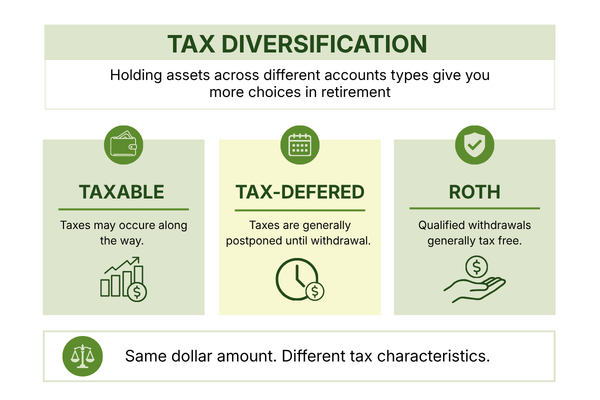
It means holding money across accounts that may receive different tax treatment.
For example, retirement assets might include:
- Tax-deferred accounts, where taxes are generally postponed until money is withdrawn.
- Roth accounts, where qualified withdrawals are generally tax-free.
- Taxable accounts, where interest, dividends, and realized capital gains may create tax consequences along the way.
Why it matters:
A $100,000 balance doesn’t necessarily represent the same amount of spendable money in every type of account.
Taxes can affect how much of your money is ultimately available to you.
Having assets with different tax characteristics may also create different choices when deciding where retirement spending will come from.
5. Cost Basis 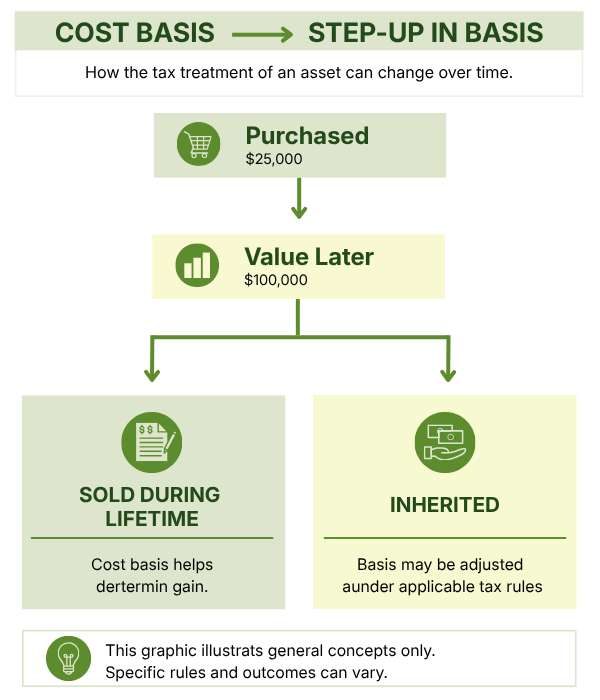
Definition: Generally, the amount used to determine your gain or loss when an investment or other asset is sold.
For a simple investment purchase, your starting cost basis is generally what you paid for the investment, although certain transactions and adjustments can change it over time.
Suppose you purchased an investment for $20,000 and later sold it for $35,000.
Your taxable gain isn’t necessarily $35,000.
Your starting point for determining the gain would generally be the difference between the sale proceeds and your adjusted cost basis.
Why it matters:
As you approach retirement, you may begin thinking differently about taxable investments you’ve accumulated over the years.
Two investments worth exactly the same amount today can have very different unrealized gains—and potentially very different tax consequences if sold.
Knowing an asset’s value tells you what it’s worth.
Knowing its cost basis helps you understand another part of the picture: what may happen for tax purposes if you sell it.
6. Step-Up in Basis
Cost basis becomes particularly important when you start thinking about estate and legacy planning.
Under current federal tax law, certain inherited assets generally receive a new cost basis based on their fair market value at the owner’s date of death, or another permitted valuation date. This is commonly called a step-up in basis, although the basis can technically adjust either up or down.
Here’s a simplified example:
Someone purchases stock for $25,000.
Years later, it’s worth $100,000.
If the owner sells it during their lifetime, that $75,000 increase in value may factor into the calculation of a capital gain.
If the asset is instead held until death and inherited, its basis may generally be adjusted to its value for estate-tax purposes, often its fair market value at the owner’s death. If that value were $100,000, the heir’s new basis could generally be $100,000.
Why it matters:
This is one reason investment, tax, and estate decisions shouldn’t always be viewed separately.
An asset isn’t simply something you own. Its tax characteristics, how long you’ve owned it, whether you sell it, and whether you eventually leave it to someone else can all matter.
And not every asset receives the same treatment. Retirement accounts such as traditional IRAs and 401(k)s have different tax rules, for example.
7. Required Minimum Distribution (RMD)
Definition: The minimum amount that generally must be withdrawn annually from certain tax-deferred retirement accounts after reaching the applicable starting age.
Traditional IRAs and many employer-sponsored retirement accounts received favorable tax treatment while money was being accumulated.
Eventually, the IRS generally requires some of that money to begin coming out, and potentially being taxed.
Those required withdrawals are called Required Minimum Distributions, or RMDs.
Why it matters:
RMDs aren’t simply an issue for the year you first have to take one.
They can become part of a much larger retirement tax picture, including your taxable income and how much money remains in tax-deferred accounts later in life.
Understanding that RMDs exist before they begin can help you understand why retirement tax planning often starts years before the required distributions themselves.
8. Roth Conversion
Definition: Moving money from an eligible pre-tax retirement account into a Roth IRA and generally recognizing the converted amount as taxable income in the year of the conversion.
A Roth conversion doesn’t make the tax disappear.It changes when the tax is paid.
Instead of leaving all the money in a tax-deferred account and generally paying ordinary income tax when it is withdrawn later, a conversion moves money into a Roth account, where qualified future withdrawals are generally tax-free.
Why it matters:
The years surrounding retirement can sometimes look very different from a tax perspective.
Income may change when a paycheck stops. Social Security may begin later. RMDs may not have started yet.
Understanding Roth conversions helps you understand an important retirement-planning question:
Is paying a tax today potentially different from paying it later?
The answer depends on the individual’s circumstances, tax situation, and future assumptions, which is exactly why a Roth conversion isn’t automatically the right move simply because it’s available.
9. Sequence-of-Returns Risk
Definition: The risk that the timing of investment gains and losses can affect how long a portfolio lasts when money is being withdrawn.
This concept becomes especially important around retirement.
While you’re accumulating money, a market decline can be uncomfortable. But if you’re still contributing and don’t need to withdraw from the portfolio, you may have time for markets to recover.
Retirement introduces another variable:
withdrawals.
If significant market declines occur early in retirement while you’re also withdrawing money, you may have to sell more investments to generate the same amount of cash.
That leaves fewer assets participating in a potential recovery.
Why it matters:
Two retirees could theoretically experience similar average investment returns over a period of time but have different outcomes depending on when the positive and negative returns occur and when withdrawals are made.
That’s why approaching retirement changes the conversation from simply:
“What return did my investments earn?”
to:
“How do these investments need to support my life?”
Knowing the Terms Helps You Ask Better Questions
You don’t need to become an expert in tax law, investments, or retirement regulations before you retire. But understanding the language makes it much easier to participate in the decisions.
And that’s really what these terms have in common.
Time horizon asks when you’ll need your money.
Risk tolerance and capacity ask how much uncertainty you can emotionally and financially handle.
Asset allocation asks how your investments are structured.
Tax diversification, cost basis, and step-up in basis ask how taxes can affect what you own, sell, withdraw, or eventually leave behind.
RMDs and Roth conversions introduce decisions surrounding tax-deferred retirement money.
And sequence-of-returns risk begins shifting the conversation from accumulating assets to using them.
That last shift is a big one.
Because eventually, retirement planning stops being primarily about building the pile and starts becoming about turning what you’ve built into money you can actually live on.
That’s where an entirely new vocabulary appears: withdrawal rates, systematic withdrawals, income floors, guaranteed income, longevity risk, and more.
We’ll tackle those next in 7 Retirement Income Terms That Confuse Almost Everyone.

Frequently Asked Questions
What financial terms should I know before retiring?
Important terms include time horizon, risk tolerance and risk capacity, asset allocation, tax diversification, cost basis, step-up in basis, required minimum distributions, Roth conversions, and sequence-of-returns risk. These concepts become increasingly relevant as the focus shifts from accumulating money to preparing to use it in retirement.What is the difference between risk tolerance and risk capacity?
Risk tolerance describes how comfortable you are with investment uncertainty and market fluctuations. Risk capacity describes how much financial risk your circumstances and goals can reasonably withstand. You can have a high tolerance for risk but a lower financial capacity to take it—or vice versa.Why does cost basis matter in retirement?
Cost basis is generally used to determine the gain or loss when an investment is sold. Two taxable investments with the same current value can have very different cost bases, which can result in different tax consequences when they’re sold.What is a step-up in basis?
Under current federal tax law, certain inherited assets generally receive an adjusted basis based on their value for estate-tax purposes, often their fair market value at the owner’s death. This can affect the capital gain recognized if the beneficiary later sells the inherited asset. Specific rules and exceptions apply.What’s the difference between an RMD and a Roth conversion?
A required minimum distribution, or RMD, is an amount that generally must be withdrawn from certain tax-deferred retirement accounts after reaching the applicable starting age. A Roth conversion is an elective transaction that moves eligible pre-tax retirement assets to a Roth IRA and generally creates taxable income in the year of conversion.Why is sequence-of-returns risk important near retirement?
Sequence-of-returns risk refers to the effect that the timing of investment gains and losses can have when withdrawals are being taken from a portfolio. Significant losses early in retirement, combined with withdrawals, can affect a portfolio differently than the same losses occurring when withdrawals aren’t being made.Understanding the Terms Is Just the Beginning
Knowing the language can make retirement planning easier to understand. The next step is figuring out how all the pieces, your investments, taxes, income, Social Security, healthcare, and the life you want to live, fit together.
At Being Financial, we help bring those pieces into one financial plan designed around where you are today and where you want to go next.
Disclosure
Asset allocation does not ensure a profit or protect against a loss.
A Roth IRA conversion—sometimes called a backdoor Roth strategy—is a way to contribute to a Roth IRA when income exceeds standard limits. The converted amount is treated as taxable income and may affect your tax bracket. Federal, state, and local taxes may apply. If you’re required to take a minimum distribution in the year of conversion, it must be completed before converting.
To qualify for tax-free withdrawals, you must generally be age 59½ and hold the converted funds in the Roth IRA for at least five years. Each conversion has its own five-year period, and early withdrawals may be subject to a 10% penalty unless an exception applies. Income limits still apply for future direct Roth IRA contributions.
This material is for informational purposes only and does not constitute tax, legal, or investment advice. Please consult a qualified tax professional regarding your individual circumstances.