
Make Social Security & Medicare Part of the Bigger Retirement Picture
Social Security and Medicare come with plenty of rules, dates, acronyms, and decisions. But the most important questions are rarely just about the rules.
When should I start Social Security? Can I afford to retire before Medicare? What happens to my spouse if I die first? Will a Roth conversion increase my Medicare premiums?
The answers depend on much more than your age.
At Being Financial, we help retirees and pre-retirees understand how Social Security and Medicare fit alongside retirement income, taxes, investments, healthcare, long-term care, family priorities, and the life they want to build in retirement.
We cannot predict exactly how long you will live, what markets will do, how healthcare needs will change, or what Congress may do decades from now. Financial planning does not require pretending that we can.
Instead, we use the information available today, pressure-test the variables we cannot control, and build backup plans for the road ahead.
The plan is the journey. Social Security and Medicare are important landmarks along the way, not the destination.
What Social Security & Medicare Planning Actually Includes
Social Security and Medicare planning involves more than choosing enrollment dates.
These decisions can affect retirement income, taxes, healthcare costs, investments, spouses, survivors, and the resources available later in life. That is why we believe they should be evaluated as part of a documented financial plan rather than one decision at a time.
Social Security Claiming Strategy
One of the most common retirement questions we hear is:
“When should I take Social Security?”
There is no universal best age.
Choosing when to begin benefits may involve evaluating:
- your retirement timeline
- current and future income needs
- other guaranteed income sources
- investment assets
- health and longevity
- family longevity
- marital status
- spousal and survivor benefits
- taxes
- whether you plan to continue working
- long-term care considerations
- legacy goals
If we knew exactly when you were going to die, Social Security planning would be much easier.
We don’t. Instead, we make an educated decision using what we know about your financial plan, health, family, goals, resources, and priorities, and build enough flexibility into the plan to respond when life does something different.
Social Security as Part of Retirement Income
Social Security should not necessarily be evaluated as a standalone monthly check.
For some retirees, the more useful question is:
“How should Social Security work with everything else I have?”
Retirement income may also come from:
- pensions
- retirement accounts
- investment portfolios
- annuities
- rental income
- business income
- cash reserves
- other assets
Sometimes using portfolio assets or other resources while delaying Social Security may be worth evaluating. In other situations, beginning Social Security earlier may better support the plan.
The goal is to understand how Social Security fits into the entire retirement income strategy, not simply to maximize one number.
Spousal, Survivor & Divorced-Spouse Planning
Social Security decisions can affect more than one person.
For married couples, claiming decisions may influence the income available to a surviving spouse later in life. This can be particularly important when one spouse has a significantly larger benefit.
Divorced individuals may also qualify for benefits based on a former spouse’s earnings record when Social Security’s eligibility requirements are met.
We help clients understand which questions need to be evaluated so claiming decisions consider the household and long-term plan, not just the benefit someone receives today.
Working While Receiving Social Security
You can work while receiving Social Security, but depending on your age and earnings, your benefits may be affected.
Because Social Security rules and earnings limits can change over time, we prefer not to build a retirement strategy around a number that may be different next year.
Instead, we help clients evaluate how employment income, Social Security, taxes, retirement accounts, and the timing of retirement work together. For current earnings limits and program rules, the Social Security Administration should be the primary source.
Medicare Enrollment Planning
Medicare creates another major decision point on the retirement journey.
Planning may involve:
- understanding when Medicare eligibility begins
- coordinating enrollment with employer coverage
- understanding Parts A and B
- evaluating prescription drug coverage
- considering supplemental coverage
- avoiding potential coverage gaps or enrollment penalties
- coordinating Medicare with retirement timing
- preparing for healthcare costs throughout retirement
Medicare rules change, which is why Medicare.gov should remain the primary source for current enrollment requirements and program details.
Our role is different. We help you understand how those Medicare decisions fit into the financial plan surrounding them.
Medicare IRMAA Planning
Retirement income decisions can sometimes affect Medicare costs.
Income-Related Monthly Adjustment Amounts, commonly called IRMAA, may result in higher Medicare premiums for people whose income exceeds applicable thresholds.
That can become important when evaluating decisions such as:
- Roth conversions
- retirement account withdrawals
- investment gains
- business income
- property sales
- charitable giving strategies
- other significant taxable events
This is one reason tax planning and Medicare planning should not happen in separate silos. We do not believe the answer is automatically, “Don’t cross the IRMAA threshold.”
A Roth conversion, for example, could increase Medicare costs and still make sense within the broader retirement plan.
The job of planning is to understand the tradeoff.
Retiring Before Medicare
We frequently hear some version of: 
“I want to retire before Medicare begins, but I guess that means I have to keep working.”
Maybe. Maybe not.
Healthcare before Medicare is a real expense, and it needs to be planned for. But healthcare costs do not automatically get to choose your retirement date.
Depending on the situation, options may include employer or retiree coverage, coverage through a spouse, ACA Marketplace coverage, COBRA, part-time employment with benefits, or other available solutions.
We often describes this decision as buying back your time.
If someone has saved and invested well enough to retire, the question may not simply be, “How can I avoid paying for health insurance?”
It may be:
“What is another five years of my time worth to me?”
The answer is personal. Our job is to help put numbers around the options so you can make the decision with greater clarity.
Social Security, Medicare & Long-Term Care
Social Security and Medicare are also pieces of the later-life planning conversation.
Social Security can provide income throughout retirement and includes cost-of-living adjustments. Medicare helps cover certain healthcare expenses.
Neither one, by itself, is a long-term care plan.
We help clients think about how these work later in life:
- Social Security income
- retirement assets
- insurance
- healthcare coverage
- potential long-term care expenses
- family support
- housing
- legacy priorities
The goal is to help create resources and flexibility so you have more choices about how and where you receive care as you age.
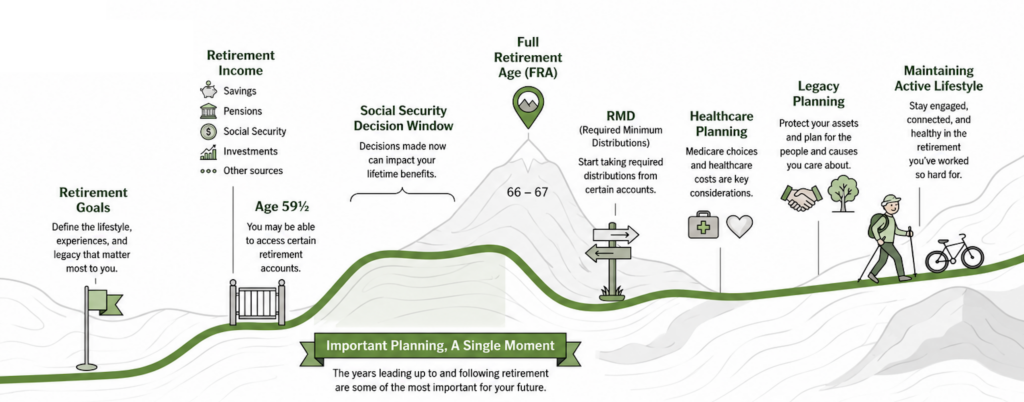
Social Security & Medicare Are Part of the Retirement Roadmap
Social Security and Medicare are important, but neither should drive the entire retirement plan.
A comprehensive retirement conversation asks:
- When do you actually want to retire?
- What do you want retirement to look like?
- How much will that life cost?
- Where will your income come from?
- Which income sources are guaranteed and which are market-dependent?
- How will that income be taxed?
- How will you pay for healthcare before and after Medicare?
- How does your Social Security decision affect your spouse?
- What happens if you live significantly longer than expected?
- What happens if government programs change?
- What resources do you want available later in life?
This is where Social Security and Medicare planning becomes financial planning.
We can model different claiming ages, retirement dates, income strategies, healthcare costs, market environments, and other assumptions. We can also pressure-test the plan for circumstances outside our control.
You cannot control every variable on the journey. You can prepare for more than one route.
That is the purpose of the Retirement Roadmap: organizing the decisions ahead so you can see how Social Security, Medicare, income, taxes, investments, and the life you want in retirement fit together.
Why Clients Seek Social Security & Medicare Planning
Most people do not come to us because they want to become experts on Social Security or Medicare.
They come because one of these decisions is standing between them and something they want to do.
“I Don’t Know When to Start Social Security”
Should you claim earlier and receive income sooner? Should you wait for a larger monthly benefit? What if you live a long time? What if you don’t?
There is no single claiming age that works for everyone.
We help clients compare the options within the context of longevity, retirement income, investments, taxes, spouses, survivor needs, and the broader financial plan.
“I’m Worried Social Security Won’t Be There for Me”
Concerns about the future of Social Security are understandable.
The program faces long-term funding challenges, and future lawmakers may change taxes, benefits, eligibility rules, or other parts of the system. What those changes will ultimately look like is outside our control. We refer to this as governmental risk.
Rather than trying to predict exactly what Washington will do, we can pressure-test a financial plan under different Social Security assumptions and focus on the variables you have more control over: savings, spending, retirement timing, investments, taxes, and flexibility.
“I Want to Retire Before Medicare”
The years between retirement and Medicare eligibility can feel like a roadblock.
We help clients estimate the cost of healthcare coverage and evaluate it alongside the rest of the retirement plan.
Sometimes the answer is continuing to work. Sometimes it isn’t.
The goal is to make the decision because it supports your life and financial plan, not simply because age 65 became the default finish line.
“My Spouse and I Have Very Different Social Security Benefits”
When spouses have different earnings histories, Social Security becomes a household decision.
Claiming strategies may affect current retirement income as well as the income available to a surviving spouse later.
We help couples look beyond two individual benefit statements and consider how the benefits work together over both lifetimes.
“I’m Divorced. Can I Receive a Benefit Based on My Ex-Spouse?”
Possibly.
Social Security provides divorced-spouse benefits when certain eligibility requirements are met. A former spouse’s remarriage does not automatically prevent an eligible divorced spouse from receiving benefits based on that work record.
We help clients identify benefits they may need to investigate and incorporate eligible benefits into the broader retirement plan.
“I Want to Keep Working After I Start Social Security”
Working and receiving Social Security can overlap.
Depending on your age and earnings, employment may affect current benefits and taxes.
Rather than looking at the Social Security decision alone, we help clients evaluate work income, benefits, taxes, investments, and retirement goals together.
“I Want to Delay Social Security, but I Need Income”
Waiting to claim Social Security does not mean living without income.
For some clients, portfolio assets, cash reserves, pensions, or other income sources can provide a bridge. Whether that makes sense depends on investment risk, taxes, longevity expectations, other guaranteed income, and the rest of the retirement plan.
This is an income-planning decision, not simply a Social Security decision.
“I’m Considering a Roth Conversion and Don’t Want to Accidentally Increase Medicare Costs”
This is exactly the kind of situation where financial decisions can collide.
A Roth conversion may affect taxable income. Taxable income may affect Medicare premiums. Both may affect the long-term retirement strategy.
When these conversations happen separately, opportunities can be missed or decisions can work against one another.
We help clients evaluate the tradeoffs and coordinate with their CPA and other professionals when appropriate.
Social Security & Medicare Essentials
Social Security and Medicare come with plenty of rules, but the bigger questions are usually personal. These quick answers cover some of the decisions we hear most often, and show why the answer frequently depends on how each piece fits into your broader retirement plan.
“When should I take Social Security?”
There is no universal best age.
The decision may depend on longevity, health, retirement timing, other income, investments, taxes, marital status, survivor needs, and what you value most from your retirement income.
If someone tells you there is one age that is always best, they are probably leaving out a large part of the picture.
“How do I maximize my Social Security benefit?”
First, define what maximize means.
The largest monthly check is not necessarily the same thing as the largest lifetime benefit or the best decision for your financial plan.
Social Security planning should consider expected longevity, household benefits, retirement income needs, taxes, investments, and what happens to a surviving spouse.
“Can I work while collecting Social Security?”
Yes.
Depending on your age and earnings, working may affect benefits. Because the applicable limits can change, check current Social Security Administration rules when making the decision.
The planning question is how employment income, Social Security, taxes, and retirement goals work together.
“Can I retire before Medicare?”
Possibly.
Medicare eligibility is an important planning milestone, but it does not automatically determine when you can afford to retire.
The question is whether your retirement plan can support healthcare coverage during the gap.
“Can my income increase my Medicare premiums?”
Potentially.
Medicare uses income-related adjustments for certain beneficiaries. Decisions that increase taxable income may therefore affect Medicare costs.
That is why Roth conversions, investment gains, retirement withdrawals, and other taxable events should be evaluated within the broader plan rather than in isolation.
“What happens to Social Security when my spouse dies?”
A surviving spouse may be eligible for survivor benefits based on Social Security rules and the couple’s benefit history.
This is why claiming decisions for married couples should consider more than the income received while both spouses are alive.
“Does Medicare pay for long-term care?”
Medicare provides healthcare coverage but generally does not function as comprehensive long-term custodial care coverage.
Long-term care deserves its own planning conversation involving assets, insurance, family support, housing, and the kind of choices you want available later in life.
These are good starting questions. But some decisions deserve a deeper look. Social Security claiming strategies, Medicare costs, survivor benefits, and healthcare planning can involve important tradeoffs that become clearer when viewed in the context of your income, taxes, investments, family, and long-term goals.
Below, we take a closer look at some of the questions that come up most often in retirement planning.

Social Security & Medicare FAQs
When should I take Social Security at 62, full retirement age, or 70?
There is no universal answer.
Starting earlier generally means receiving benefits sooner at a lower monthly amount. Delaying can result in a larger monthly benefit, subject to Social Security rules.
But comparing monthly checks is only part of the decision.
We also consider:
- expected longevity
- personal health
- family longevity
- retirement income needs
- investment assets
- other guaranteed income
- marital status
- survivor benefits
- taxes
- employment
- long-term care planning
- personal goals and values
If we knew your exact date of death, the math would be much easier.
Since we don’t, financial planning uses the information available today to make an educated decision and builds backup plans for the things we cannot predict.
I heard Social Security is going away. Shouldn’t I start my benefit right away?
Not necessarily.
Social Security faces long-term financial challenges, and future changes to the program are possible. But making an irreversible retirement decision based solely on predictions about what lawmakers may eventually do can create a different kind of risk.
We think of this as governmental risk: an important variable that is largely outside your control.
Instead of trying to predict Congress, we can pressure-test the retirement plan using different assumptions about future Social Security benefits.
Then we focus on the variables you have more ability to influence.
For the latest projections about Social Security’s finances, use the Social Security Administration’s current Trustees Report rather than relying on a static number published on a financial planning website.
How do I maximize Social Security benefits?
Start by deciding what you are trying to maximize.
Do you want the largest monthly benefit? The greatest estimated lifetime income? More income earlier in retirement? Greater survivor income for a spouse? More flexibility from other assets?
Those are not always the same objective.
We evaluate Social Security alongside longevity assumptions, goals, cash flow, assets, potential investment growth, taxes, other income, and the broader retirement plan.
Because no one knows exactly how long they will live, maximizing Social Security is ultimately an informed planning decision rather than a perfect calculation.
What is the Social Security break-even point?
The break-even point compares the cumulative benefits received under different claiming ages.
If you claim earlier, you generally receive smaller payments for more years.
If you delay, you generally receive fewer years of payments initially but a larger monthly benefit.
At some point, the cumulative benefits under the two strategies may cross. That is the break-even point.
It can be a useful comparison, but it should not make the decision by itself.
Taxes, investment returns, portfolio withdrawals, survivor benefits, longevity, and personal preferences can all change the bigger picture.
Why does my life expectancy matter for Social Security?
Because Social Security is generally a lifetime stream of income.
The longer you receive benefits, the more important the size of that ongoing income may become.
That makes longevity an important part of the claiming decision. We may consider personal health, family history, lifestyle, and other available information—but none of those tells us exactly how long someone will live.
Planning means making a reasonable assumption and preparing for the possibility that reality will be different.
What happens to my spouse’s Social Security if I die?
A surviving spouse may qualify for survivor benefits under Social Security rules.
In many cases, the household moves from receiving two benefits while both spouses are alive to one benefit after a spouse dies. Which benefit continues depends on the applicable Social Security rules and the couple’s benefit history.
That potential reduction in household income is one reason claiming decisions should consider both spouses and not just the person whose benefit is being evaluated.
Can I receive Social Security based on my ex-spouse’s work record?
Possibly.
Social Security allows eligible divorced individuals to receive benefits based on a former spouse’s work record when certain requirements are met.
Eligibility depends on factors including the length of the marriage, age, marital status, and other Social Security requirements.
Receiving an eligible divorced-spouse benefit does not reduce the former spouse’s own Social Security benefit.
Because program rules can change, the Social Security Administration should be used to confirm current eligibility.
Can I work while collecting Social Security?
Yes.
However, depending on your age and earnings, Social Security may temporarily withhold some benefits under its earnings rules.
The applicable earnings limits change over time, so we recommend checking the current Social Security Administration rules rather than relying on a static dollar amount.
From a planning perspective, we evaluate how earned income, Social Security, taxes, retirement contributions, and your desired retirement timeline work together.
Is it smart to spend portfolio assets while I wait to claim Social Security?
Sometimes.
For some retirees, using portfolio assets or other income sources while delaying Social Security can be worth evaluating because delaying benefits can increase the future monthly benefit up to the applicable age under Social Security rules.
This may be attractive to someone who expects to live a long time, values predictable lifetime income, or has few other guaranteed income sources.
But spending portfolio assets also has consequences.
Investment returns, market conditions, taxes, withdrawal rates, other income, survivor needs, and legacy goals all matter.
This is exactly why the answer is not simply, “Always delay Social Security.”
The answer lives in the plan.
When should I start my Social Security benefit?
The short answer:
We don’t know. Your financial plan should help us figure it out.
The appropriate claiming strategy depends on your life, resources, goals, health, family, spouse, taxes, retirement date, and income needs.
Social Security provides the rules. Financial planning helps determine how those rules fit you.
How does long-term care planning affect my Social Security strategy?
One goal of retirement planning is to maintain resources and flexibility later in life, when healthcare and support needs may increase.
Social Security can be an important source of lifetime income and includes cost-of-living adjustments. That can make it particularly relevant when thinking about income later in retirement.
But Social Security alone is not a long-term care strategy.
We evaluate it alongside assets, insurance, healthcare coverage, family resources, housing, and other sources of income to help prepare for the choices you may want later in life.
When should I enroll in Medicare?
For many people, Medicare eligibility begins around age 65, with an Initial Enrollment Period surrounding that milestone.
However, the right enrollment timing can depend on circumstances such as active employer coverage and other qualifying coverage.
Enrollment rules and deadlines matter, and they can change. Medicare.gov should be used to verify the current requirements for your situation.
Our role is to help incorporate Medicare timing and healthcare costs into the broader retirement plan.
What is IRMAA, and can my income make Medicare cost more?
IRMAA stands for Income-Related Monthly Adjustment Amount.
Depending on income, some Medicare beneficiaries pay additional premiums for certain Medicare coverage.
This becomes a financial planning issue because decisions such as Roth conversions, retirement account withdrawals, investment gains, business income, and other taxable events may affect the income Medicare uses to determine premiums.
That does not mean those strategies should automatically be avoided.
We help clients compare the potential additional Medicare cost with the potential long-term benefit of the strategy being considered.
Sometimes paying more in one area may support a better overall financial outcome. The tradeoff needs to be evaluated within the complete plan.
What about Medicare supplemental plans?
Supplemental coverage may help some retirees make healthcare costs more predictable and reduce certain out-of-pocket expenses.
Being Financial does not sell Medicare supplemental plans.
We can help clients understand how healthcare costs fit into their retirement budget and financial plan, and when appropriate, coordinate with independent professionals who specialize in Medicare coverage.
For current coverage rules and plan information, Medicare.gov and appropriately licensed Medicare professionals should be used.
I want to retire before Medicare. Do I need to keep working until 65?
Not necessarily.
The years before Medicare create a healthcare funding problem to solve, not necessarily a requirement to keep working.
Depending on your circumstances, potential coverage sources may include:
- employer or retiree coverage
- a spouse’s employer plan
- ACA Marketplace coverage
- COBRA
- part-time employment offering benefits
- other coverage available to you
We help clients estimate those costs and incorporate them into the retirement plan.
For some people, working longer is the right answer. For others, paying for healthcare may be the cost of buying back several years of their time.
That is a financial decision, but it is also a life decision.
What about Medicare Advantage? Can it save me money?
Medicare Advantage and Original Medicare structure coverage differently, and either may be appropriate depending on an individual’s circumstances.
Important considerations can include:
- premiums
- out-of-pocket costs
- provider networks
- prescription coverage
- travel
- referrals and prior authorization
- supplemental coverage
- individual healthcare needs
We do not believe a financial planning website should tell everyone that one Medicare structure is universally better than another.
Being Financial does not sell Medicare plans. We help clients incorporate anticipated healthcare costs into the retirement plan and can coordinate with independent Medicare professionals when plan-specific guidance is needed.
Medicare.gov should be used for current program information and plan comparisons.
Social Security & Medicare Planning in Virginia, New Jersey, and Beyond
Retirement decisions are personal, but where and how you live can affect the planning surrounding them.
At Being Financial, we help retirees and pre-retirees in Harrisonburg, throughout the Shenandoah Valley, across Virginia, in our satellite office in Medford, New Jersey, and nationwide coordinate Social Security and Medicare decisions with the rest of their retirement plan.
Some clients plan to remain in the same community throughout retirement. Others relocate, spend time in multiple states, move closer to family, continue working remotely, or travel extensively.
Those choices may affect healthcare access, insurance decisions, spending, taxes, family support, and the kind of retirement income flexibility someone needs.
Wherever retirement takes you, Social Security and Medicare work best when they are considered within the context of the life you are actually planning to live.
Social Security & Medicare Decisions Should Support Your Retirement, Not Define It
There are plenty of rules surrounding Social Security and Medicare.
Your retirement is bigger than those rules.
The goal is not to find the perfect claiming age, predict exactly how long you will live, guess what Congress will do, or eliminate every possible healthcare expense.
The goal is to understand your options, evaluate the tradeoffs, prepare for uncertainty, and make informed decisions within the context of your broader retirement roadmap.
A good guide cannot remove every unknown from the trail.
A good guide can help you understand the terrain, prepare for different conditions, and know which decisions matter before you reach the next turn.
Start the Conversation
You do not need to understand every Social Security or Medicare rule before beginning retirement planning.
Many people start with questions like:
- “When should I take Social Security?”
- “Can I afford to retire before Medicare?”
- “What happens to my spouse if I die first?”
- “Will my Social Security be enough?”
- “Could a Roth conversion increase my Medicare premiums?”
- “How do healthcare costs fit into my retirement budget?”
- “What if Social Security changes?”
- “Am I missing something?”
Those are exactly the kinds of questions a retirement roadmap is designed to help organize.
Whether you are approaching retirement, deciding when to claim Social Security, preparing for Medicare, evaluating an early retirement, or simply looking for a second perspective, the first step is often just starting the conversation.