Tax Planning for Retirement, Wealth, and Life Transitions
Taxes influence far more than what happens each April.
They show up in some of life’s biggest financial decisions: when to retire, how to create income, whether a Roth conversion makes sense, how to give to charity, when to sell a business, how investments are structured, and what kind of legacy you hope to leave behind.
Tax preparation looks backward at what already happened. Tax planning looks forward. It helps you evaluate decisions before they are made, so taxes can be considered alongside retirement income, investments, estate planning, charitable giving, business transitions, and long-term family goals.
At Being Financial, we help retirees, pre-retirees, business owners, and families throughout Harrisonburg, the Shenandoah Valley, Virginia, from our satellite office in Medford, New Jersey, and across the United States understand how tax decisions fit into the bigger financial picture.
Our role is not to replace your CPA or attorney. It is to help coordinate the planning conversation, identify questions worth exploring, and work alongside your other professionals when tax, legal, investment, and retirement decisions overlap.
Because taxes are rarely isolated. They are often one of the connective threads running through the entire financial journey. The goal is not to avoid taxes at all costs. The goal is to make informed decisions within the rules, with a clearer understanding of how today’s choices may affect the road ahead.
What Tax Planning Actually Includes
Tax planning is not one strategy or one annual conversation. It is an ongoing part of the financial planning process, especially as income, investments, retirement timelines, family priorities, tax laws, and business interests change over time.
At Being Financial, tax planning is integrated into the broader plan because tax decisions often affect more than the current year. A decision that lowers taxes today may create challenges later. A decision that increases taxes this year may create more flexibility in retirement. The value comes from understanding the tradeoffs before acting.
Tax planning may include:
Retirement Tax Planning
Retirement often changes where income comes from and how it is taxed.
Instead of receiving one paycheck, retirement income may come from several sources, including investment accounts, IRAs, Roth IRAs, pensions, Social Security, business income, rental income, or cash reserves.
Retirement tax planning helps evaluate how those income sources may work together over time.
This may include:
- retirement account withdrawal strategies
- Social Security taxation
- pension income decisions
- Required Minimum Distributions, or RMDs
- Roth conversion opportunities
- Medicare-related income considerations
- charitable giving strategies
- taxable investment income
The goal is not simply to create income, but to understand how income decisions may affect taxes, spending flexibility, healthcare costs, and long-term sustainability throughout retirement.
Roth Conversion Planning
A Roth conversion involves moving money from a pre-tax retirement account into a Roth account and paying taxes on the converted amount in the year of conversion.
For some households, Roth conversions may be worth evaluating during years when taxable income is temporarily lower, such as the years after retiring but before Required Minimum Distributions begin.
Roth conversion planning may involve reviewing:
- current and projected future tax brackets
- retirement income needs
- Required Minimum Distributions
- Social Security taxation
- Medicare premium thresholds
- estate planning goals
- future flexibility for heirs
A Roth conversion is not automatically the right answer. It is a timing decision, and timing matters. The question is whether paying taxes today may create more flexibility later within the larger financial plan.
Tax Diversification
Many people understand investment diversification but overlook tax diversification.
Tax diversification means having assets in accounts with different tax treatments, such as:
- taxable brokerage accounts
- tax-deferred retirement accounts
- Roth accounts
Each type of account may be taxed differently. Having more than one tax bucket can create flexibility when deciding where retirement income should come from, how much taxable income to recognize in a given year, and how to respond if tax laws change in the future.
Tax diversification does not eliminate taxes. It may give you more options for managing taxes over time.
Retirement Withdrawal Strategies
The order in which money is withdrawn during retirement can affect taxes, portfolio longevity, Medicare costs, charitable giving opportunities, and the amount eventually passed to heirs.
Withdrawal strategy may involve coordinating:
- taxable accounts
- traditional IRAs and 401(k)s
- Roth accounts
- pensions
- Social Security
- annuities
- cash reserves
- business or rental income
For some retirees, it may make sense to draw from taxable accounts first. For others, partial IRA withdrawals or Roth conversions before RMD age may be worth evaluating. The right approach depends on the entire retirement roadmap, not a simple rule of thumb.
Tax-Efficient Investing
Investment decisions can create tax consequences, especially in taxable accounts.
Tax-efficient investing may involve evaluating:
- where different investments are held
- capital gains exposure
- dividend and interest taxation
- tax-loss harvesting opportunities
- turnover within investment accounts
- charitable gifting of appreciated assets
- coordination between investment allocation and withdrawal strategy
The investment strategy and tax strategy should not operate separately. They should support the same plan.
Charitable Giving Strategies
For many families, charitable giving is about values first. Tax planning can help make that generosity more intentional.
Charitable giving strategies may include:
- Qualified Charitable Distributions, or QCDs
- Donor-Advised Funds
- gifting appreciated securities
- bunching charitable deductions
- charitable trusts
- family giving conversations
- legacy giving goals
The purpose is not to let taxes drive generosity. The purpose is to coordinate giving in a way that supports the causes you care about while fitting into the broader financial plan.
Business Owner Tax Planning
Business owners often face tax decisions that overlap with retirement planning, estate planning, compensation, succession, and investment strategy.
Planning may include conversations around:
- retirement plan design
- business succession
- preparing for a business sale
- capital gains planning
- compensation strategies
- hiring family members
- charitable giving before or after a sale
- coordinating personal and business cash flow
These decisions often require collaboration with CPAs, attorneys, and other professionals. Our role is to help organize the financial planning side of the conversation so business decisions, retirement goals, and tax considerations are not being evaluated in isolation.
Estate and Legacy Tax Coordination
Tax planning can also affect the wealth you hope to pass to future generations or give to causes that matter to you.
Estate and legacy tax coordination may involve:
- beneficiary designations
- inherited retirement accounts
- cost basis considerations
- trust coordination
- charitable giving strategies
- family wealth transfer
- business succession planning
- multigenerational planning conversations
Estate planning documents are legal tools, and those should be created with an attorney. But the financial decisions surrounding those documents often benefit from coordination. Tax planning helps connect the legal, financial, charitable, and family pieces of the legacy conversation.
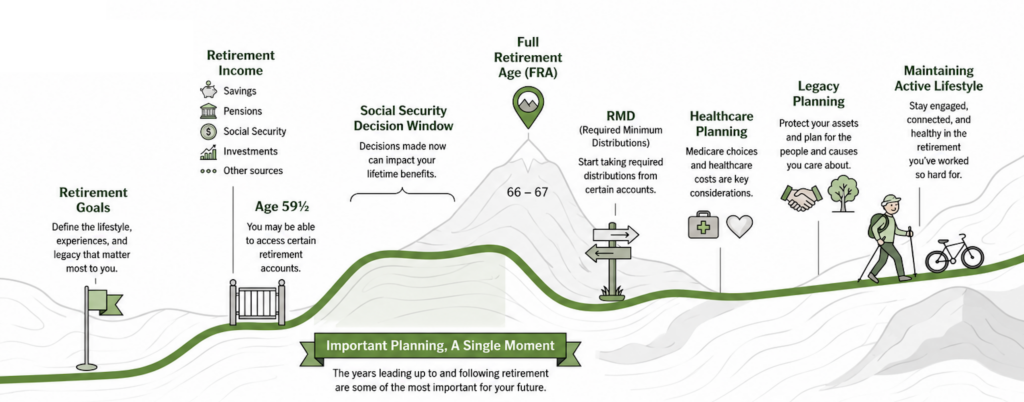
How Tax Planning Supports Your Retirement Roadmap
Retirement planning is not just about deciding when work ends. It is about understanding how income, taxes, investments, healthcare, lifestyle, and legacy may work together over time.
That is why tax planning is an important part of the retirement roadmap.
Many retirement decisions have tax consequences, and many tax decisions affect retirement flexibility. Looking at them together can help create a clearer path forward.
Identifying Tax Windows Before Retirement
Some of the most important tax planning opportunities may happen in the years just before or just after retirement.
For many people, there may be a period when earned income has decreased, but Required Minimum Distributions have not yet begun. That window may create opportunities to evaluate:
- Roth conversions
- strategic retirement account withdrawals
- charitable giving strategies
- capital gains realization
- tax bracket management
- Medicare-related income thresholds
- future RMD exposure
These decisions should not be made in isolation. The purpose is to understand whether taking action today may create more flexibility later.
Coordinating Retirement Income Sources
Retirement income may come from many different places.
Those sources may include:
- Social Security
- pensions
- traditional IRAs
- Roth IRAs
- 401(k)s
- taxable investment accounts
- annuities
- rental income
- business income
- cash reserves
Each source may be taxed differently. The order, timing, and amount of income taken from each source can affect the overall retirement picture.
A retirement roadmap should help answer not only “Where will my income come from?” but also “How will that income be taxed?”
Evaluating Roth Conversion Opportunities
Roth conversions are often discussed as a tax strategy, but they are really a planning strategy.
A conversion may affect:
- current-year taxes
- future retirement income flexibility
- Required Minimum Distributions
- Medicare premiums
- Social Security taxation
- estate planning
- inherited retirement accounts
- tax flexibility for heirs
The question is not simply whether Roth accounts are good. The question is whether a Roth conversion fits the route you are trying to take.
Planning Around Required Minimum Distributions
Required Minimum Distributions can significantly affect taxable income later in retirement.
For some retirees, RMDs may create higher taxable income than expected. They may also affect Medicare premiums, Social Security taxation, charitable giving opportunities, and the long-term tax treatment of inherited retirement accounts.
Tax planning before RMD age can help evaluate whether there are decisions worth considering earlier, while there may still be more control over taxable income.
Considering Medicare-Related Income Thresholds
Taxes and healthcare costs can intersect in retirement.
For some retirees, higher income may affect Medicare premiums. That does not mean income should always be kept lower. It means Medicare-related thresholds should be part of the planning conversation when evaluating Roth conversions, investment gains, retirement withdrawals, business income, or other taxable events.
A coordinated plan helps clients understand the tradeoffs before making decisions.
Connecting Charitable Giving to the Retirement Plan
For retirees who give generously, charitable planning can become part of the retirement roadmap.
Depending on the situation, strategies such as Qualified Charitable Distributions, Donor-Advised Funds, appreciated securities, or bunching deductions may be worth discussing.
The goal is not to let taxes drive generosity. The goal is to align giving with personal values, income planning, tax strategy, and legacy goals.
Preparing for Legacy and Family Impact
Retirement tax planning can also influence what happens beyond your lifetime.
Decisions around Roth conversions, beneficiary designations, charitable giving, inherited retirement accounts, estate planning, and business succession may affect the people and organizations you care about.
A thoughtful retirement roadmap should look beyond the next tax return and consider how today’s choices may shape the future for your family, your community, and the causes that matter most to you.
Avoiding Isolated Decisions
One of the biggest risks in tax planning is making decisions one at a time without seeing how they connect.
A Roth conversion may look attractive until Medicare premiums are considered.
A business sale may create opportunities that should be discussed before the transaction closes.
A charitable gift may be more effective in one year than another.
A retirement withdrawal strategy may affect taxes, investments, and estate planning at the same time.
The plan is the journey, and tax planning helps mark important turns along the way. Our role is to help guide the conversation so tax decisions support the broader retirement roadmap rather than pulling the plan off course.
Tax Planning Does Not Happen in Isolation
Tax planning often works best when the right professionals are communicating with one another.
Your financial life may involve several different advisors, including your CPA, estate planning attorney, insurance professional, business attorney, benefits provider, or other specialists. Each person may play an important role, but the planning can become fragmented when everyone is looking at only one piece of the picture.
At Being Financial, our role is not to replace your CPA or attorney.
Your CPA remains the professional responsible for tax preparation and tax-specific guidance. Your attorney remains the professional responsible for legal documents and legal advice. Our role is to help organize the financial planning conversation, identify areas where tax considerations may affect the broader plan, and coordinate with your other professionals when decisions overlap.
Why Coordination Matters
Many financial decisions involve more than one area of expertise.
For example:
- A Roth conversion may involve tax projections, retirement income planning, investment strategy, and estate planning.
- Selling a business may involve capital gains, retirement timing, cash flow, charitable giving, and legal structure.
- Updating an estate plan may involve beneficiary designations, inherited retirement accounts, insurance, and family wealth transfer.
- Charitable giving may involve tax deductions, appreciated assets, retirement account distributions, and long-term legacy goals.
- Retirement income planning may involve Social Security, Medicare, RMDs, investment withdrawals, and taxable income management.
When these conversations happen separately, opportunities can be missed or decisions can work against one another.
A coordinated planning process helps bring the right questions to the table before decisions are finalized.
Working With Your CPA
Many clients already have a CPA they know and trust. That relationship can be incredibly valuable.
We can help support that relationship by helping clients think through planning questions such as:
- Should we evaluate Roth conversions this year?
- Will retirement income change our tax bracket?
- How might RMDs affect future taxable income?
- Should charitable giving be coordinated differently?
- What tax questions should be reviewed before selling a business?
- Are there planning opportunities before the end of the year?
- How do investment withdrawals affect the broader tax picture?
We do not prepare tax returns. Instead, we help clients understand where tax planning may fit into the larger financial strategy and coordinate with tax professionals when appropriate.
Working With Your Estate Planning Attorney
Tax planning can also intersect with estate planning.
Estate planning documents should be created by an attorney, but the financial planning around those documents often involves important coordination.
This may include:
- beneficiary designations
- trust funding considerations
- inherited retirement accounts
- charitable giving goals
- family wealth transfer
- business succession planning
- insurance planning
- cost basis considerations
The legal documents matter. So does the strategy behind them.
When your financial plan and estate plan are aligned, it becomes easier to understand how retirement decisions, tax planning, charitable goals, and legacy priorities fit together.
Working With Business Owners and Their Advisory Team
Business owners often need even more coordination because personal and business finances are deeply connected.
Tax planning for business owners may involve conversations with a CPA, attorney, valuation professional, retirement plan provider, insurance specialist, or other advisors.
We help business owners evaluate how decisions may affect both the business and the personal financial plan, including:
- retirement readiness
- business succession
- sale proceeds
- compensation planning
- retirement plan design
- charitable giving
- family involvement in the business
- estate and legacy planning
Business decisions are rarely just business decisions. They often affect the owner’s family, retirement, taxes, lifestyle, and long-term goals.
One Map, One Coordinated Direction
A strong financial plan should not require every professional to do the same job.
It should help each professional understand the route.
Tax planning is one part of that map. Retirement planning, investment management, estate planning, risk management, charitable giving, and business planning all add additional context.
Our role is to help guide the financial planning conversation so the professionals around you can work from a more coordinated view of where you are, where you are going, and what decisions may matter along the way.
Why Clients Seek Tax Planning
People often begin thinking about tax planning when a specific question or transition brings taxes into focus.
Sometimes the question is simple:
“Am I paying more in taxes than I need to?”
Other times, the question is more complex:
“How do my tax decisions affect retirement, my family, my business, and the legacy I want to build?”
Tax planning can be especially valuable when financial decisions are becoming more interconnected. The more moving pieces someone has, the more important it becomes to understand how taxes fit into the larger picture.
You Are Approaching Retirement
The years before retirement can create important planning opportunities.
Income may be changing. Retirement accounts may be growing. Social Security decisions may be approaching. Required Minimum Distributions may be on the horizon. Healthcare costs and Medicare premiums may become part of the conversation.
Tax planning during this stage can help evaluate:
- whether Roth conversions should be considered
- how retirement income may be structured
- when withdrawals should begin
- how Social Security timing may affect taxable income
- how future RMDs may influence retirement cash flow
- whether charitable giving should be coordinated differently
For many people, this is the point when tax planning shifts from something that happens once a year to something that becomes part of the retirement roadmap.
You Recently Retired
Retirement can create a new financial rhythm.
Instead of earning a paycheck, income may come from investments, pensions, retirement accounts, Social Security, cash reserves, or other sources. Each source may be taxed differently.
The early years of retirement may also create planning opportunities before RMDs begin. This is often when clients begin asking whether they should take withdrawals sooner, complete partial Roth conversions, realize capital gains, or adjust charitable giving strategies.
Tax planning can help evaluate these decisions before they become urgent.
Your Income Has Changed
A significant income change can create new tax questions.
This may happen because of:
- retirement
- a job change
- a bonus year
- stock options or deferred compensation
- business income
- the sale of property
- inheritance
- divorce
- the death of a spouse
- a business transition
When income changes, tax planning can help evaluate whether there are decisions to make before year-end, whether future tax brackets may look different, and how the change affects the broader financial plan.
You Are Considering a Roth Conversion
Roth conversions often raise more questions than they answer.
Should you convert this year?
How much should you convert?
Will it affect Medicare premiums?
Could it increase Social Security taxation?
Does it help your heirs?
Is it worth paying taxes now for possible flexibility later?
These questions cannot usually be answered by looking at one tax year alone. Roth conversion planning works best when it is evaluated alongside retirement income, projected tax brackets, investment strategy, healthcare costs, estate planning, and long-term goals.
You Own a Business
Business owners often have more tax planning complexity because personal and business finances are connected.
Tax planning may become important when:
- cash flow changes
- compensation decisions need to be evaluated
- retirement plan options are being considered
- family members work in the business
- succession planning begins
- a business sale is being explored
- charitable giving is tied to business income or a liquidity event
A business decision may affect personal taxes, retirement readiness, estate planning, and family goals. Coordinating with your CPA, attorney, and financial planning team can help prevent those decisions from being made in separate silos.
You Are Preparing to Sell a Business or Property
The sale of a business, real estate, or another highly appreciated asset can create significant tax questions.
Before a sale is finalized, it may be helpful to evaluate:
- capital gains considerations
- charitable giving opportunities
- installment sale possibilities
- estate planning implications
- retirement income needs
- reinvestment strategy
- timing of income recognition
- whether other professionals should be brought into the conversation
Some planning opportunities may be limited once the transaction is complete. That is why conversations before the sale can be especially important.
You Want to Give More Intentionally
For many clients, charitable giving is not simply a tax strategy. It is an expression of values.
Tax planning can help evaluate how generosity fits into the broader financial picture. Depending on the situation, this may include Qualified Charitable Distributions, Donor-Advised Funds, appreciated securities, charitable trusts, or bunching deductions into certain tax years.
The goal is not to give because of taxes. The goal is to give in a way that supports both the causes you care about and the financial plan guiding the rest of your life.
You Want to Avoid Surprises
Some people seek tax planning because they have been surprised before.
A larger-than-expected tax bill, Medicare premium increase, capital gains event, taxable inheritance, or unexpected RMD can make people realize how connected tax decisions are to the rest of their financial life.
Tax planning cannot eliminate uncertainty, but it can help identify questions earlier, organize the moving pieces, and create a clearer framework for decision-making.
You Want Your Financial Life to Feel More Coordinated
Tax planning is often less about one single strategy and more about coordination.
It helps answer questions like:
- Are my retirement income decisions working with my tax strategy?
- Are my investments located in the right types of accounts?
- Are my charitable goals being planned intentionally?
- Are my estate planning decisions aligned with my financial plan?
- Are my CPA, attorney, and advisor working from the same map?
When tax planning is coordinated with the rest of the financial plan, decisions can become easier to evaluate with context.

Tax Planning FAQs
What is tax planning?
Tax planning is the process of evaluating financial decisions before they happen so tax considerations can be understood in advance.
It may involve retirement income, investment withdrawals, Roth conversions, charitable giving, business transitions, estate planning, Social Security, Medicare-related income thresholds, and family wealth transfer.
Tax planning is not about avoiding taxes at all costs. It is about making informed decisions within the rules and understanding how those decisions may affect your broader financial picture over time.
Thorough tax planning often asks:
- What decisions do we still have time to make?
- How will this affect taxable income now and later?
- Does this strategy support the retirement plan?
- Are there tradeoffs we need to understand?
- Should the CPA, attorney, or another professional be part of the conversation?
The goal is to help tax decisions support the overall financial journey rather than become isolated choices.
What is the difference between tax planning and tax preparation?
Tax preparation looks backward. Tax planning looks forward.
Tax preparation focuses on reporting what already happened during the previous tax year. It helps determine what should be filed, what is owed, what deductions apply, and whether a refund or payment is due.
Tax planning happens before decisions are finalized. It may involve evaluating retirement withdrawals, Roth conversions, charitable giving, investment gains, business income, estate planning, or other decisions that could affect taxes in the current year and future years.
Both are important, but they serve different purposes.
Tax preparation answers:
- What happened?
- What do I owe?
- What forms need to be filed?
Tax planning asks:
- What decisions are coming?
- What options do we still have?
- How could this affect future taxes?
- How does this fit into the broader plan?
At Being Financial, we do not prepare tax returns. We help clients think through how tax decisions connect to retirement, investments, business ownership, charitable giving, estate planning, and long-term goals.
How do I mitigate taxes in retirement?
Mitigating taxes in retirement usually requires more than looking for deductions.
Retirement tax planning may involve coordinating several moving pieces, including:
- retirement account withdrawals
- Roth conversions
- taxable investment income
- Social Security taxation
- Required Minimum Distributions
- pensions
- charitable giving
- Medicare-related income thresholds
- estate planning goals
Sometimes reducing taxes in one year may increase taxes later. Other times, choosing to recognize more taxable income today may create more flexibility in the future.
That is why retirement tax planning should be evaluated over many years, not only one tax season.
The goal is not always to pay the lowest possible tax bill this year. The goal is to create a thoughtful strategy that supports retirement income, flexibility, healthcare considerations, and long-term family priorities.
What is tax diversification?
Tax diversification means having assets in different types of accounts that are taxed differently.
Many people diversify their investments by spreading money across different asset classes. Tax diversification applies a similar concept to account types.
Common tax buckets may include:
- Taxable accounts, such as brokerage accounts
- Tax-deferred accounts, such as traditional IRAs and 401(k)s
- Tax-free or tax-advantaged accounts, such as Roth IRAs or Roth 401(k)s when rules are followed
Each bucket may create different opportunities and tradeoffs.
Having money in different tax buckets may allow for more flexibility when deciding where retirement income should come from, how much taxable income to recognize, whether Roth conversions make sense, or how to respond if tax laws change.
Tax diversification does not eliminate taxes. It may give you more options for managing taxes over time.
What are the three tax buckets?
The three tax buckets are a simple way to understand how different accounts may be taxed.
Taxable
These accounts are usually funded with after-tax dollars. Investment income, dividends, interest, and realized capital gains may be taxable along the way.
Examples may include:
- brokerage accounts
- individual investment accounts
- jointly held investment accounts
Tax-deferred
These accounts may provide tax benefits when money goes in, but withdrawals are generally taxable later.
Examples may include:
- traditional IRAs
- traditional 401(k)s
- 403(b)s
- SEP IRAs
- SIMPLE IRAs
Roth
Roth accounts are generally funded with after-tax dollars. When rules are met, qualified withdrawals may be tax-free.
Examples may include:
- Roth IRAs
- Roth 401(k)s
A coordinated tax strategy often considers how these buckets work together, especially when creating retirement income.
Should I convert my 401(k) or IRA to a Roth before retirement?
A Roth conversion may be worth evaluating before retirement or during the early retirement years, but it is not automatically the right choice.
When you convert pre-tax retirement dollars to a Roth account, the converted amount generally becomes taxable in the year of conversion. In exchange, the Roth account may provide more tax flexibility later if rules are followed.
A Roth conversion may be considered when:
- current income is temporarily lower
- future tax rates may be higher
- Required Minimum Distributions may become significant
- heirs may benefit from receiving Roth assets
- retirement income flexibility is a priority
- charitable giving or estate planning goals are involved
However, a conversion may also affect current-year taxes, Medicare premiums, Social Security taxation, cash flow, and other planning decisions.
The question is not simply, “Should I convert?”
The better question is, “Does a conversion support the route we are trying to take?”
What is a Roth conversion?
A Roth conversion is the process of moving money from a pre-tax retirement account into a Roth account.
The converted amount is generally treated as taxable income in the year of conversion. Once the money is in the Roth account, future qualified withdrawals may be tax-free if IRS rules are met.
Roth conversions are often discussed in retirement planning because they may help create more tax flexibility later. They may also reduce future Required Minimum Distributions, depending on the situation.
A Roth conversion may be worth evaluating during:
- lower-income years
- early retirement years before RMDs begin
- years before Social Security starts
- years when charitable giving is also being planned
- estate planning conversations involving heirs
However, Roth conversions can also create unintended consequences if not coordinated carefully. They may increase current-year taxes, affect Medicare premiums, influence Social Security taxation, or push income into a higher tax bracket.
The value of a Roth conversion is not simply whether Roth accounts are attractive. The value comes from understanding whether converting now supports the larger retirement and tax plan.
What is a Backdoor Roth?
A Backdoor Roth is a strategy sometimes used by higher-income earners who are not eligible to make direct Roth IRA contributions.
In general, the strategy involves making a nondeductible contribution to a traditional IRA and then converting those funds to a Roth IRA. While the concept may sound simple, the tax treatment can become more complicated if the individual already has other pre-tax IRA assets.
That is because of IRS aggregation and pro-rata rules, which may affect how much of the conversion is taxable.
A Backdoor Roth may be worth discussing if:
- income is too high for direct Roth IRA contributions
- long-term tax flexibility is important
- retirement savings are already being maximized elsewhere
- existing IRA balances are understood
- the tax reporting can be handled correctly
This is a good example of why tax planning and tax preparation need to communicate. A strategy may look attractive, but the details matter.
What is a Mega Backdoor Roth?
A Mega Backdoor Roth is a strategy that may be available through certain employer retirement plans.
It generally involves making after-tax contributions to a workplace retirement plan and then converting those after-tax dollars to a Roth account, if the plan allows it.
Not every employer plan permits this strategy. The rules depend on the plan design, contribution limits, testing requirements, and how the plan handles after-tax contributions and Roth conversions.
A Mega Backdoor Roth may be relevant for high-income earners who:
- are already maximizing other retirement savings opportunities
- have access to a retirement plan that allows after-tax contributions
- want additional Roth savings capacity
- understand the tax and plan-specific rules involved
- are coordinating with their financial and tax professionals
Because this strategy depends heavily on employer plan rules, it should be reviewed carefully before acting.
How do I control my tax bracket?
Tax bracket planning is about understanding how income is recognized over time.
Some income may be unavoidable. Other income may have more flexibility around timing. Tax planning can help evaluate whether it makes sense to recognize more income in one year, less income in another, or spread income across multiple years.
Tax bracket planning may involve:
- retirement account withdrawals
- Roth conversions
- capital gains
- charitable giving
- business income
- bonuses
- deferred compensation
- pension elections
- Social Security timing
The goal is not always to stay in the lowest possible bracket every year. Sometimes it may make sense to intentionally fill a lower tax bracket today to help reduce pressure later.
This is especially relevant for people approaching retirement, business owners with fluctuating income, and retirees who have not yet reached RMD age.
What are Required Minimum Distributions?
Required Minimum Distributions, often called RMDs, are mandatory withdrawals from certain retirement accounts once account owners reach the applicable age.
RMDs generally apply to tax-deferred retirement accounts, such as traditional IRAs, traditional 401(k)s, 403(b)s, SEP IRAs, and SIMPLE IRAs.
RMDs matter because they can increase taxable income later in retirement. Higher taxable income may also affect:
- Social Security taxation
- Medicare premiums
- charitable giving strategies
- tax bracket planning
- investment withdrawal decisions
- estate planning for inherited retirement accounts
RMD planning often begins before RMDs are required. Earlier planning may include Roth conversions, charitable giving strategies, or withdrawal coordination designed to create more flexibility later.
What is a Qualified Charitable Distribution?
A Qualified Charitable Distribution, often called a QCD, allows eligible IRA owners to direct money from an IRA to a qualified charity.
For retirees who are charitably inclined, QCDs may be a useful planning tool because they can sometimes satisfy all or part of a Required Minimum Distribution while keeping the donated amount out of taxable income.
QCDs may be worth discussing when someone:
- is already giving to charity
- has reached the eligible age
- has IRA assets
- does not need all of their RMD for spending
- wants charitable giving to fit into their retirement income plan
QCDs must follow specific rules, including rules around eligible accounts, eligible charities, timing, and direct transfers. They should be coordinated carefully with the client’s CPA and financial planning team.
What is a cost basis step-up?
A cost basis step-up refers to the adjustment that may occur when certain appreciated assets are inherited.
In general, when someone inherits an appreciated asset, the asset’s cost basis may be adjusted to its value at the date of death, depending on the asset type and applicable rules. This can affect how much capital gain may be recognized if the asset is later sold.
Cost basis planning may matter when families own:
- taxable investment accounts
- real estate
- business interests
- concentrated stock positions
- highly appreciated assets
This is one reason tax planning, estate planning, and investment planning often need to work together.
Not every asset receives the same treatment. Retirement accounts, for example, are generally handled differently than taxable investment assets. That makes coordination especially important before assets are sold, gifted, or transferred.
How can charitable giving reduce taxes?
Charitable giving may create tax planning opportunities when it is coordinated intentionally.
Depending on the situation, strategies may include:
- donating appreciated securities
- using a Donor-Advised Fund
- making Qualified Charitable Distributions from an IRA
- bunching charitable gifts into one tax year
- naming charities as beneficiaries
- considering charitable trusts in more advanced planning situations
The right strategy depends on the client’s goals, assets, income, age, giving priorities, and broader financial plan.
Taxes should not be the only reason to give. But when generosity is already part of the plan, tax planning can help determine how and when giving may be structured more effectively.
I’m selling a business. What should I think about before the sale?
The sale of a business can create major financial, tax, legal, and emotional decisions.
Before the sale is finalized, it may be helpful to evaluate:
- expected sale proceeds
- capital gains considerations
- deal structure
- timing of income recognition
- retirement readiness
- charitable giving opportunities
- estate planning updates
- investment strategy for proceeds
- insurance needs
- cash flow after the sale
- coordination with CPA and attorney
Some planning opportunities may need to happen before the transaction is complete. Waiting until after the sale may limit available options.
At Being Financial, we help business owners think through how a potential sale fits into the broader financial plan and coordinate with other professionals when tax, legal, investment, and retirement decisions overlap.
Is tax planning worth it?
Tax planning may be valuable when financial decisions are becoming more complex or when taxes affect multiple parts of the plan.
It may be especially helpful for people who are:
- approaching retirement
- recently retired
- evaluating Roth conversions
- selling a business or property
- receiving stock options or deferred compensation
- giving significantly to charity
- preparing for RMDs
- coordinating estate planning
- managing income across multiple sources
The value of tax planning is not only measured by one year’s tax bill. It may also come from better coordination, fewer surprises, clearer decision-making, and a plan that helps taxes, retirement income, investments, charitable giving, and legacy goals work together over time.
Tax Planning in Harrisonburg, Virginia, Medford, New Jersey, and Beyond
Tax laws may be national, but tax planning is personal.
The right tax planning conversation depends on where you are in life, how your income is structured, what assets you own, where you plan to retire, how you give, what kind of business interests you may have, and what you hope to pass on to the next generation.
At Being Financial, we help individuals, families, retirees, pre-retirees, and business owners in Harrisonburg, throughout the Shenandoah Valley, across Virginia, in Medford, New Jersey, and across the United States coordinate tax planning with the broader financial picture.
For many clients, tax planning conversations may involve:
- retirement income decisions
- Roth conversion opportunities
- Required Minimum Distributions
- charitable giving
- business ownership
- real estate or land ownership
- investment gains
- stock compensation
- estate planning
- family wealth transfer
- relocation in retirement
- multistate family or business considerations
In the Shenandoah Valley, tax planning conversations often intersect with retirement decisions, business ownership, agriculture or land ownership, charitable giving, family legacy, and the desire to remain connected to the local community.
In Medford and other parts of New Jersey, clients may be navigating different state tax considerations, higher housing costs, retirement relocation questions, multigenerational planning, or family ties across multiple states.
And for clients working virtually across the country, the planning process remains the same: organize the moving pieces, identify the questions worth exploring, coordinate with the appropriate professionals, and help tax decisions support the broader plan.
Tax planning is not about geography alone. It is about context.
Where you live, how you earn income, where your family lives, where your assets are held, and where you hope your life is headed can all shape the conversation.
A coordinated plan helps bring those details together so tax decisions are not made in isolation.
Tax Planning Should Help You Make More Informed Decisions
Tax planning is not about finding one perfect strategy.
It is about creating a process for evaluating decisions with greater context before action is taken.
Taxes can influence retirement income, investment withdrawals, charitable giving, business transitions, estate planning, Medicare premiums, Social Security taxation, and the wealth eventually passed to family or charitable organizations. When those decisions are evaluated separately, the plan can become fragmented.
A coordinated tax planning process helps bring the pieces together.
It can help you understand:
- what decisions may need attention before year-end
- whether a Roth conversion is worth evaluating
- how retirement income may be taxed
- how future RMDs could affect your plan
- whether charitable giving could be structured more intentionally
- how a business sale may affect retirement and legacy goals
- what questions should be discussed with your CPA or attorney
- how tax decisions fit into the broader financial journey
The goal is not to predict every future tax law change or eliminate taxes altogether. The goal is to build a more thoughtful framework for decision-making so taxes are considered before they become a surprise.
Start the Conversation
Tax planning does not require having every answer figured out before reaching out.
Many people begin the process with questions they have been carrying for years:
- “Am I missing tax planning opportunities?”
- “Should I be doing Roth conversions?”
- “How will taxes affect my retirement income?”
- “What happens when RMDs begin?”
- “How should I think about charitable giving?”
- “What should I consider before selling my business?”
- “Are my CPA, attorney, and financial planning team working from the same map?”
Tax planning often becomes easier once the moving pieces are organized into a clearer framework.
Whether you are preparing for retirement, evaluating Roth conversions, coordinating charitable giving, navigating a business transition, or simply looking for a second perspective, the first step is often just starting the conversation.
Most introductory meetings begin with a conversation about your goals, priorities, and the areas of planning you would like to better understand.
Important Disclosure
A Roth IRA conversion—sometimes called a backdoor Roth strategy—is a way to contribute to a Roth IRA when income exceeds standard limits. The converted amount is treated as taxable income and may affect your tax bracket. Federal, state, and local taxes may apply. If you’re required to take a minimum distribution in the year of conversion, it must be completed before converting.
To qualify for tax-free withdrawals, you must generally be age 59½ and hold the converted funds in the Roth IRA for at least five years. Each conversion has its own five-year period, and early withdrawals may be subject to a 10% penalty unless an exception applies. Income limits still apply for future direct Roth IRA contributions.
A “mega backdoor Roth” strategy can potentially allow some people to save more in a Roth IRA and/or Roth 401(k) than they otherwise would be able to. Whether or not the strategy is available to you depends on the specific features of your 401(k) or other workplace retirement plan. If your plan permits it and you’re considering using the strategy, be sure to understand the potential tax implications, and consider whether it makes sense in the context of your other financial goals.
There is no assurance that the techniques and strategies discussed are suitable for all investors or will yield positive outcomes. The purchase of certain securities may be required to effect some of the strategies. Investing involves risks including possible loss of principal.
This material is for informational purposes only and does not constitute tax, legal, or investment advice. Please consult a qualified tax professional regarding your individual circumstances.