
12 Financial Terms Every Beginner Should Know
If you’ve ever sat through a conversation about investing, retirement, or taxes and thought, “I have no idea what that means,” you’re not alone.
Financial professionals use terms every day that can sound confusing if you’ve never been taught what they mean. The good news is you don’t need a finance degree to make sophisticated financial decisions. You simply need a solid understanding of the basics.
Whether you’re learning about budgeting, investing, retirement accounts, or simply trying to understand common financial terms, this guide introduces the financial vocabulary that forms the foundation of personalized financial planning. Understanding these basic financial terms will help you have more confident conversations, ask better questions, and make more informed financial decisions.
These financial terms for beginners introduces twelve financial terms that create the foundation for nearly every financial decision you’ll make. Whether you’re beginning your financial journey or simply want to feel more confident discussing money, these concepts are an excellent place to start.Table of Contents
- Budget
- Cash Flow
- Emergency Fund
- Compound Interest
- Inflation
- Credit Score
- Interest Rate
- Diversification
- Asset Allocation
- Risk Tolerance
- Traditional IRA
- Roth IRA
Before We Begin
You don’t need to memorize every financial term you’ll ever hear. Start with the fundamentals. These concepts build on one another and will help you better understand everything from your paycheck to your retirement plan. Think of learning financial terms the same way you learned a new language. The more words you understand, the easier every conversation becomes.1. Budget
Simple Definition
A budget is a plan for how you’ll spend, save, and use your money over a specific period of time.Why It Matters
A budget gives your money a purpose before you spend it. Rather than wondering where your paycheck went, you decide where it will go.Example
If your monthly income is $5,000 and you decide to spend $4,200 while saving or investing $800, you’ve created a monthly budget.2. Cash Flow
Simple Definition
Cash flow is the money coming into your household compared to the money going out.Why It Matters
Positive cash flow means you’re bringing in more money than you’re spending. Negative cash flow means expenses are exceeding income, which usually isn’t sustainable for long.Example
You earn $6,000 each month and spend $5,200. Your positive cash flow is $800.3. Emergency Fund
Simple Definition
An emergency fund is money set aside specifically for unexpected expenses.Why It Matters
Life happens. Job changes, medical bills, vehicle repairs, and home maintenance can all occur without warning. Having emergency savings can help you handle those situations without relying on credit cards or loans.Example
Your water heater unexpectedly fails. Instead of using a credit card, you pay for the replacement from your emergency fund.4. Compound Interest
Simple Definition
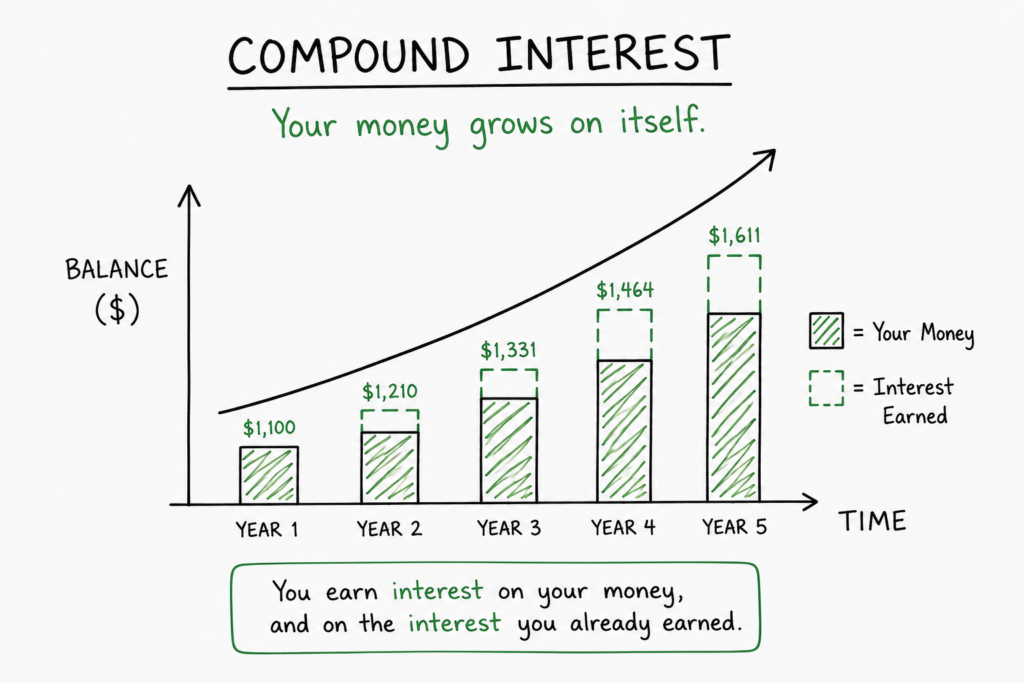
Compound interest is interest earned on both the money you originally invested or saved and the interest you’ve already earned.Why It Matters
Compounding is one of the most powerful concepts in personal finance because your money can begin earning money on itself over time. The earlier you begin saving or investing, the more time compound growth has to work.Example
If you invest $1,000 and earn interest, next year you may earn interest on more than just your original $1,000, you’ll also earn interest on last year’s growth.5. Inflation
Simple Definition
Inflation is the gradual increase in the prices of goods and services over time.Why It Matters
As prices rise, the same amount of money buys less than it once did. This is why simply saving money isn’t always enough to preserve purchasing power over the long term.Example
A gallon of milk that costs $4 today may cost more several years from now because of inflation.Common Misunderstanding
Inflation isn’t caused by a single factor. It reflects many economic forces, including supply and demand, labor costs, monetary policy, and global events.6. Credit Score
Simple Definition
A credit score is a number that helps lenders estimate how likely you are to repay borrowed money.Why It Matters
Your credit score can influence whether you’re approved for loans and the interest rate you’ll pay.Example
Two people buying the same car may receive different loan rates because they have different credit scores.7. Interest Rate
Simple Definition
An interest rate is the cost of borrowing money or the return you may earn on savings or investments.Why It Matters
Interest rates affect mortgages, auto loans, credit cards, savings accounts, certificates of deposit (CDs), and many other financial products.Example
A lower mortgage interest rate generally means lower monthly payments over the life of the loan.8. Diversification
Simple Definition
Diversification means spreading investments across different types of assets instead of putting everything into one investment.
Why It Matters
Different investments don’t always perform the same way at the same time. Diversification can potentially help reduce the impact if one investment performs poorly.Example
Instead of investing everything in one company’s stock, you own investments across many companies, industries, and asset classes.Common Misunderstanding
Diversification does not guarantee a profit or eliminate the possibility of investment losses. It is simply one way investors may manage investment risk.9. Asset Allocation
Simple Definition
Asset allocation is how your investments are divided among different categories, such as stocks, bonds, and cash.Why It Matters
Your asset allocation should reflect your goals, time horizon, and comfort with market fluctuations.Example
A younger investor saving for retirement may choose a different asset allocation than someone who plans to retire next year.10. Risk Tolerance
Simple Definition
Risk tolerance is your ability and willingness to accept investment ups and downs in pursuit of long-term goals.Why It Matters
Choosing investments that match your risk tolerance can make it easier to stay committed to your financial plan during periods of market volatility.Example
Two investors with identical incomes may have different portfolios because they have different comfort levels with market fluctuations.11. Traditional IRA
Simple Definition
A Traditional IRA is a retirement account that may allow eligible individuals to contribute money before taxes or receive a tax deduction, depending on their income and whether they’re covered by a retirement plan at work. Investments in the account have the potential to grow tax-deferred until withdrawn. These are considered "qualified accounts."Why It Matters
A Traditional IRA can help you save for retirement while potentially lowering your taxable income today. Taxes are generally paid when money is withdrawn in retirement.Example
Someone contributes to a Traditional IRA throughout their career. Their investments have the opportunity to grow over time, and they generally pay taxes when they take withdrawals in retirement.Common Misunderstanding
A Traditional IRA is not an investment. Like a Roth IRA, it is an account that can hold investments such as mutual funds, ETFs, stocks, bonds, or other eligible investments.12. Roth IRA
Simple Definition
A Roth IRA is a retirement account that allows eligible individuals to contribute money after taxes, with the potential for tax-free qualified withdrawals in retirement if IRS requirements are met. These are considered "non-qualified accounts."Why It Matters
For many investors, a Roth IRA can provide valuable flexibility in retirement because qualified withdrawals are generally tax-free.Example
A young professional contributes regularly to a Roth IRA for decades and may be able to withdraw qualified earnings tax-free in retirement.Common Misunderstanding
A Roth IRA is not an investment. It is an account that can hold investments such as mutual funds, ETFs, stocks, bonds, or other eligible investments.Financial Confidence Starts with Understanding
Learning these twelve terms won’t make you a financial expert overnight. But understanding the language of money helps you ask better questions, recognize opportunities, and make more informed decisions throughout your life. Financial planning isn’t about knowing every answer. It’s about continually learning enough to make the next good decision. Every expert was once a beginner. The important part is simply getting started.
Frequently Asked Questions
What is the most important financial term to learn first?
Budget and cash flow are excellent places to begin because they form the foundation for nearly every other financial decision.What’s the difference between saving and investing?
Saving typically involves setting money aside for shorter-term goals or emergencies. Investing generally focuses on growing money over the long term and involves varying levels of investment risk.What does diversification mean?
Diversification means spreading investments across different types of assets to help mitigate the impact of any single investment performing poorly.Is a Roth IRA an investment?
No. A Roth IRA is a retirement account that can hold different types of investments.Why is compound interest important?
Compound interest allows earnings to generate additional earnings over time, making it one of the most powerful concepts in long-term saving and investing.Why should I learn financial terms?
Understanding financial terminology helps you communicate more effectively with financial professionals, better evaluate financial decisions, and build confidence in managing your finances.Every Financial Expert Started Somewhere
Learning these twelve terms won’t make you a financial expert overnight.
But every person who feels confident making financial decisions started exactly where you are now, with a willingness to learn.
Understanding the language of money won’t eliminate every financial challenge, but it will help you ask better questions, recognize opportunities, and make more informed decisions throughout your life.
At Being Financial, we believe financial planning isn’t about having all the answers. It’s about building knowledge, making thoughtful decisions, and taking the next right step with confidence.
Whether you’re creating your first budget, opening a retirement account, or preparing for retirement years from now, every step builds on the one before it.
The journey starts with understanding.
Then comes planning.
Then comes action.
Because financial confidence isn’t built in a day, it’s built one decision at a time.
Keep Learning
This guide is the first in our Financial Terms Series, created to make financial concepts easier to understand in plain English.
Coming Soon: 8 Financial Terms Every Pre-Retiree Should UnderstandRetirement planning introduces a whole new vocabulary. In our next guide, we’ll explain terms like required minimum distributions (RMDs), Medicare IRMAA, qualified charitable distributions (QCDs), sequence of returns risk, and other concepts that become increasingly important as retirement approaches.
Important Disclosure
There is no guarantee that a diversified portfolio will enhance overall returns or outperform a non-diversified portfolio. Diversification does not protect against market risk.
Asset allocation does not ensure a profit or protect against a loss.
Contributions to a traditional IRA may be tax deductible in the contribution year, with current income tax due at withdrawal. Withdrawals prior to age 59 ½ may result in a 10% IRS penalty tax in addition to current income tax.
A Roth IRA offers tax deferral on any earnings in the account. Qualified withdrawals of earnings from the account are tax-free. Withdrawals of earnings prior to age 59 ½ or prior to the account being opened for 5 years, whichever is later, may result in a 10% IRS penalty tax. Limitations and restrictions may apply.